

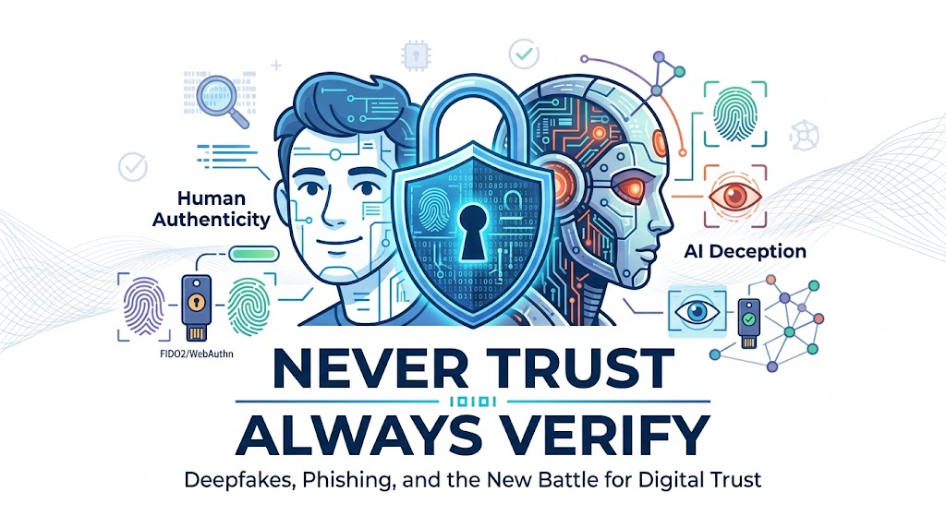
Not long ago, identifying an online scam followed a familiar playbook: check for suspicious sender addresses, bad grammar, generic greetings like "Dear Customer," or clumsy domain variations. While those basic hygiene checks still matter, relying on them today is a dangerous security trap.
Artificial intelligence has fundamentally changed the economics and mechanics of social engineering. Attackers no longer need hours to research a target or write broken scripts. With generative AI, they can analyze publicly available information, generate context-aware phishing emails, and synthesize both voice and video with unnerving realism.
This transformation demands a core shift in cybersecurity thinking. The question is no longer simply: Does this message look or sound real? It must become: How do I independently verify that the requester, the context, and the requested action are legitimate?
Modern attacks bypass technical defenses not by hacking systems, but by manipulating something traditional controls struggle to safeguard: human trust.
The AI Upgrade: How Social Engineering Has Evolved
Traditional phishing relied heavily on volume—blasting tens of thousands of generic emails and hoping a fraction of a percent would take the bait. AI eliminates that inefficiency, allowing adversaries to execute bespoke social engineering attacks at enterprise scale.
1. Phishing 2.0: Hyper-Personalized Deception
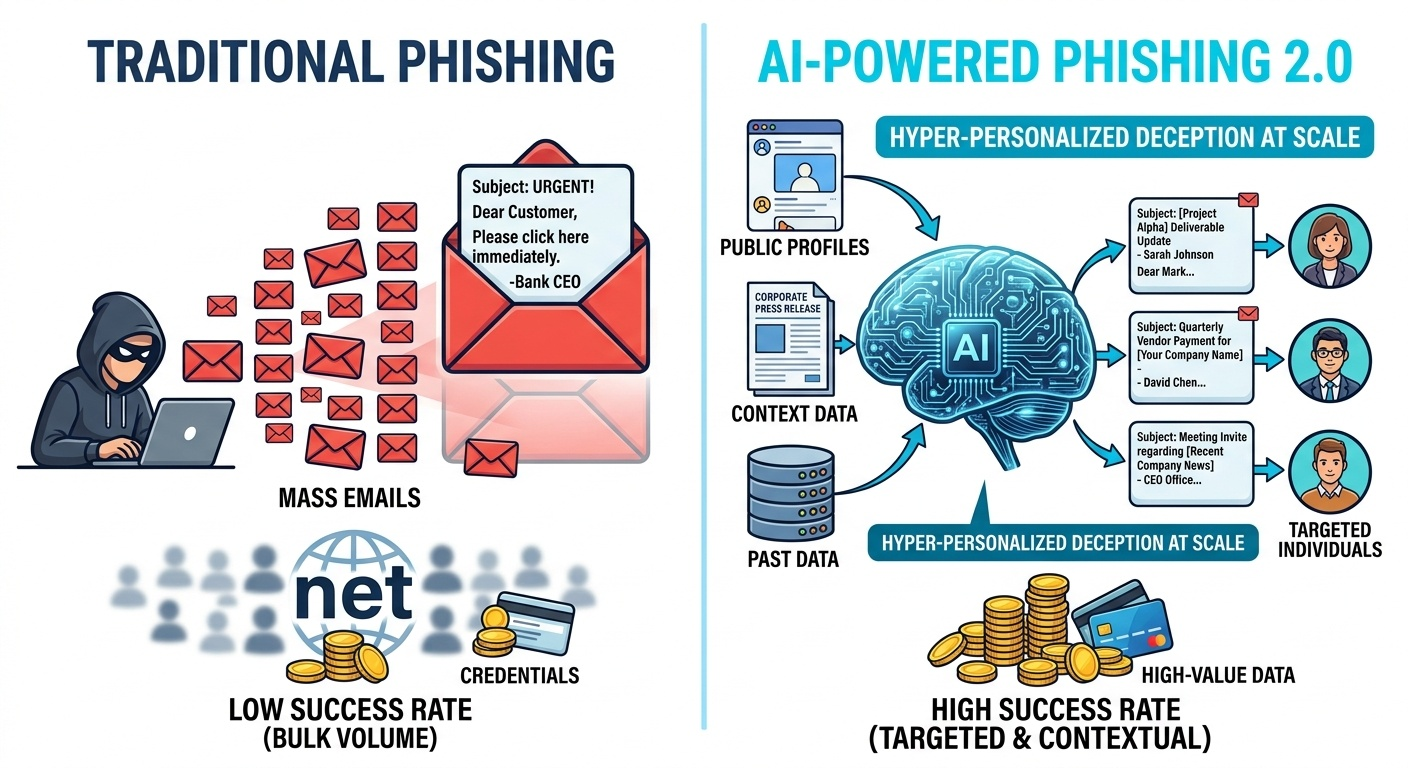
Large language models (LLMs) can produce articulate, highly natural communications across any domain. Attackers combine these models with contextual reconnaissance drawn from:
Public social media profiles and network relationships.
Corporate websites, press releases, and executive announcements.
Professional networking sites and organograms.
Stolen or breached credentials circulating on secondary markets.
Imagine an email referencing your exact current project deliverables, using your team's internal jargon, and appearing to originate from an established vendor or teammate. Because the syntax is flawless and the context aligns with your daily workflow, traditional red flags disappear. The attack succeeds not because the victim is careless, but because the request is contextually convincing.
2. Voice Cloning: When Auditory Recognition Fails
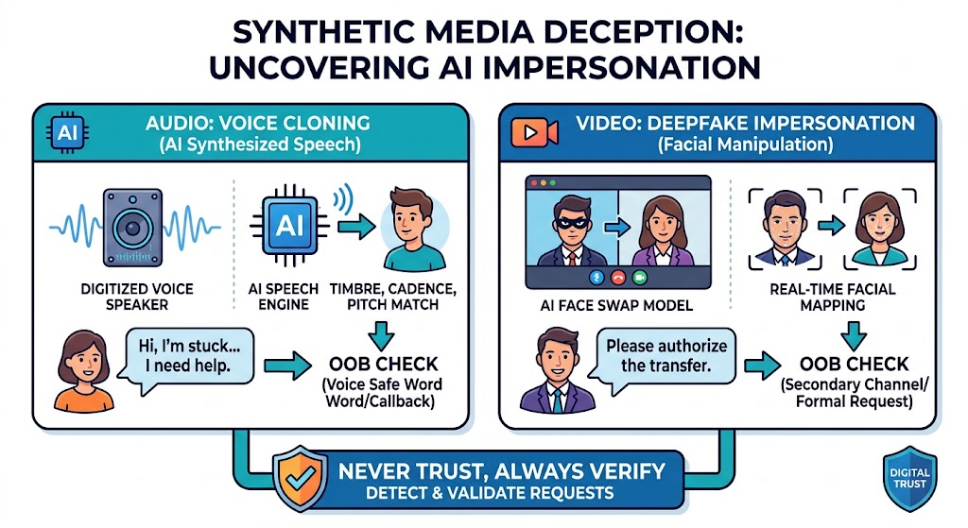
Voice cloning technology has advanced to the point where speech models can replicate timbre, pitch, inflection, and cadence using brief audio samples. While the quality and length of required audio vary by platform, attackers frequently target high-stress, emotionally charged scenarios:
A family member calling about an urgent medical or legal emergency.
An executive leaving an urgent voice memo instructing an off-cycle vendor wire.
A colleague requesting an emergency authentication pass-code.
The immediate, natural reaction is: "I know their voice, so it must be them." In an AI-enabled threat environment, audio familiarity is merely a data point—never conclusive proof of identity.
3. Deepfake Video: Seeing Is No Longer Proof
Video has historically carried a strong psychological weight: seeing a person speak creates an automatic presumption of authenticity. Real-time face swapping, digital avatars, and post-processed synthetic media weaken this assumption across job interviews, high-profile meetings, and corporate communications.
However, expecting every user to become a forensic analyst capable of spotting synthetic artifacts does not scale. Deepfake engines evolve faster than human visual pattern recognition. The effective approach is procedural: regardless of how realistic the video feed appears, any unusual or high-stakes request must trigger an out-of-band verification process.
The Core Risk: The Erosion of Digital Trust
The most dangerous consequence of AI-driven social engineering is not simply a sharper phishing campaign or an impressive synthetic video. It is the systemic breakdown of digital trust.
For decades, digital authentication relied on cognitive shortcuts:
I recognize the domain and email header.
Their writing cadence matches their usual tone.
I recognized their voice on the phone.
We spoke face-to-face over video.
The sender knew internal details only our team knows.
AI-assisted tools undermine every one of these assumptions. Because identity has become trivial to emulate, securing accounts and endpoints is no longer sufficient on its own. Organizations and individuals must actively secure the decision-making process by which digital trust is granted.
The Modern Defense: Verify the Action, Not the Appearance
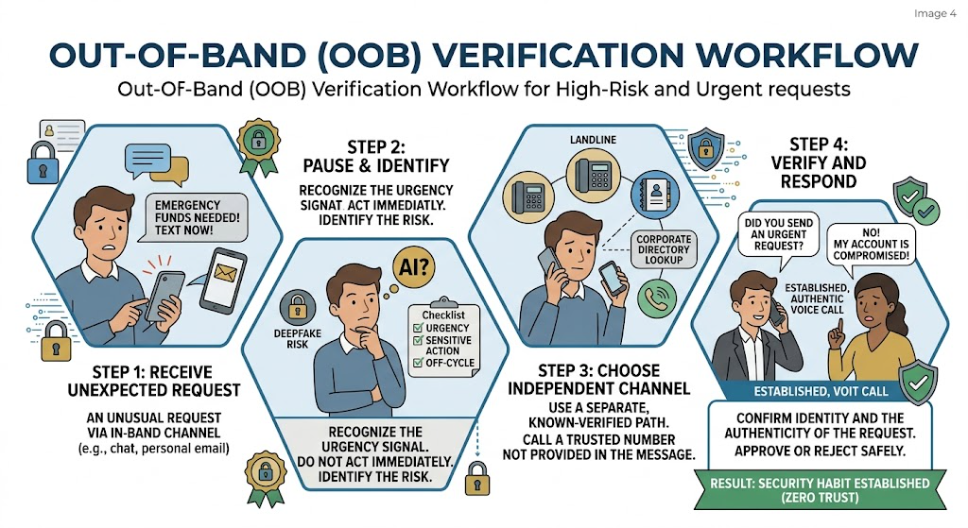
The goal is not to catch every single deepfake; the goal is to design workflows and personal habits that stay resilient even when an attacker successfully impersonates someone you know.
1. Enforce Out-of-Band (OOB) Verification
Never approve, process, or confirm sensitive actions solely through the communication channel where the request originated.
If an unexpected or urgent request involves:
Wire transfers or account modifications.
One-time passcodes (OTPs) or MFA approvals.
Password resets or credential sharing.
Confidential financial, customer, or legal records.
Verify the instruction via an independent, pre-established channel. If an executive messages via Teams or WhatsApp demanding an urgent transaction, call them on their verified, known phone line—never via contact details provided inside the suspicious thread.
2. Establish Private Authentication Protocols
For critical and high-consequence scenarios, structured pre-agreements remove guesswork:
For Families: Agree on a private offline verification word or challenge answer for purported emergencies.
For Teams: Enforce dual-custody authorization for changes to payment instructions or bank accounts, ensuring no single employee can approve wire requests based on an email thread alone.
3. Deploy Phishing-Resistant MFA
Not all Multi-Factor Authentication (MFA) architectures provide equal protection against AI-driven campaigns:
Vulnerable: SMS-based codes and voice-call OTPs can be intercepted through SIM swapping, automated voice bots, or adversary-in-the-middle (AiTM) phishing proxies.
Resilient: FIDO2/WebAuthn hardware tokens (e.g., YubiKeys) and passkeys bind authentication mathematically to the exact, legitimate domain URL. Even if a user visits a pixel-perfect phishing site generated by an AI tool, the security key will refuse to provide credentials.
4. Minimize the Attack Surface
Generative models require input data. Reviewing external digital exposure limits what adversaries can harvest:
Audit public organizational charts and employee directory disclosures.
Restrict personal information and direct contact details on social platforms.
Exercise prudence with high-definition audio and video samples published in public forums, especially for personnel with financial authority.
Decommission unused legacy accounts and third-party API integrations.
5. Treat Manufactured Urgency as a Red Flag
Psychological manipulation remains the engine of social engineering. Attackers use artificial urgency to push targets to bypass established protocols before rational skepticism can engage.
Common pressure vectors include:
Time Pressure: This must be completed in the next 15 minutes.
Coercive Authority: The board/CEO requested this directly; do not delay.
Fear & Secrecy: Legal audit underway—keep this confidential until finalized.
These signals do not instantly prove malice, but they should automatically trigger a mandatory pause: slow down and verify independently.
Organizational Controls: Building Resilient Workflows
Relying exclusively on individual employee vigilance is a flawed strategy. Organizations must formalize strict controls around high-risk transactions:
Request Type | Mandatory Control Policy |
|---|---|
Financial Wire / Transfer | Independent out-of-band voice confirmation + dual authorization |
Vendor Bank Account Change | Verification callback to pre-existing contact on master file |
Credential / Password Reset | Identity verification via separate authenticated directory |
MFA Token Re-enrollment | In-person or cryptographically signed managerial validation |
Sensitive Data Export | Explicit approval from designated data owner + logging |
Privileged Access Grant | Time-bound, just-in-time access via formal approval workflow |
The Future of Digital Identity
Artificial intelligence has not invented deception; it has scaled it, reduced its cost, and lowered the barrier to convincing execution.
In the previous era of security, the baseline instinct was:
Does this request look real?
In the age of AI, the standard must be:
What independent verification validates this request?
Our defense cannot hinge on whether we can spot every synthetic artifact, fake voice, or tailored email. It depends on building technical barriers and behavioral habits that maintain security even when external appearances are entirely compromised.
Don't rely on the appearance of identity. Verify the legitimacy behind the request.