


You can invest millions in next-generation firewalls, deploy zero-trust endpoint protection, and enforce multi-factor authentication across your entire environment. Yet, it can still take one convincing email—and one rushed decision—to create an opening for an attacker.
Modern phishing attacks increasingly target psychology rather than technical vulnerabilities. AI-generated spear-phishing emails, business email compromise, fraudulent invoice requests, QR-code phishing, and executive impersonation can be difficult to distinguish from legitimate business communication.
That is why employees shouldn't be viewed simply as the weakest link in cybersecurity. With the right training and a supportive reporting culture, they can become another layer of your defensive architecture: a Human Firewall.
A human firewall isn't an employee who never makes a mistake. It is an employee who can recognize suspicious behavior, pause before acting, report potential threats quickly, and help prevent an attack from spreading.
A modern phishing simulation program is one of the most effective ways to build that capability.
1. Shift the Mindset: Education, Not "Gotcha!"
The biggest mistake organizations make with phishing simulations is treating them as traps.
If an employee fails a simulation and immediately receives a punitive warning—or their manager is notified as a form of punishment—the organization may create fear rather than security awareness.
That can produce two dangerous behaviors:
Panic deleting: Employees delete suspicious messages instead of reporting them.
Concealment: Employees become reluctant to admit mistakes when a real incident occurs.
A stronger approach is to create psychological safety.
The purpose of a phishing simulation isn't to prove that employees can be tricked. It is to give them a safe environment to practice recognizing the same psychological techniques attackers use in real campaigns.
The objective should be simple:
Don't optimize for failure. Optimize for detection and reporting.
When employees understand that reporting a suspicious message is rewarded rather than punished, they become an active part of the organization's detection layer.
2. Establish a Baseline Before Increasing the Difficulty
Before launching sophisticated simulations, understand your organization's current behavior.
Start with a controlled baseline campaign and measure how employees respond. Useful metrics can include:
Phish-Prone Percentage (PPP)
Click or interaction rate
Reporting rate
Time to report
Repeat interaction with simulations
Department-level performance
The goal isn't to rank employees. The baseline provides a reference point for measuring improvement over time.
Increase Realism Gradually
Don't begin with the most sophisticated attack scenario you can create.
Start with obvious indicators such as:
Generic greetings
Suspicious sender domains
Unexpected attachments
Artificial urgency
Obvious requests for credentials
Once employees become comfortable identifying these patterns, introduce more realistic scenarios involving trusted vendors, internal processes, executive impersonation, or business transactions.
Make Simulations Role-Specific
Different departments face different threats.
Department | Example Simulation | Behavior to Practice |
|---|---|---|
Finance | Fake invoice or payment request | Verify payment instructions |
HR | Resume or benefits attachment | Inspect unexpected files and links |
Executives | Executive impersonation | Verify unusual requests out-of-band |
Procurement | Vendor bank-account change | Independently verify changes |
IT | Fake security alert | Validate links and authentication requests |
A finance employee doesn't need the same phishing exercise as a software engineer. Effective simulations reflect the decisions employees actually make during their working day.
3. Use Automation to Scale the Program
Running realistic phishing simulations manually can quickly become difficult.
Security teams need to create scenarios, segment employees, schedule campaigns, monitor interactions, measure reporting behavior, and deliver follow-up education.
This is where dedicated phishing-awareness platforms can help.
Solutions such as Phishtop can be used to streamline the operational side of phishing simulation programs, allowing organizations to build repeatable campaigns rather than relying on spreadsheets and manual tracking.
A platform-based approach can help organizations:
Build realistic phishing scenarios
Segment campaigns by department or risk profile
Schedule recurring simulations
Monitor employee interactions and reporting behavior
Deliver contextual awareness training
Analyze trends across campaigns
Identify areas that require additional training
The important point is that technology should support the awareness strategy—not replace it.
The best results come when simulation, reporting, education, and measurement operate as one continuous process.
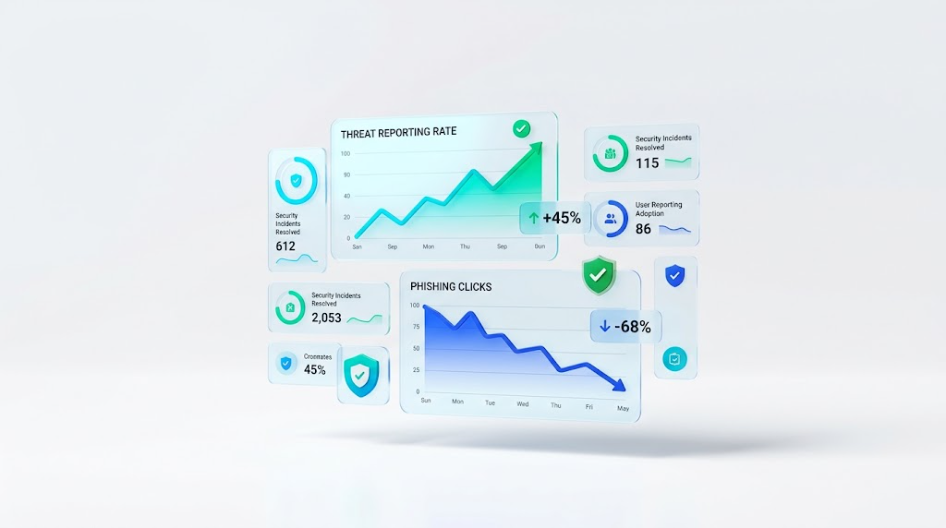
4. Measure What Actually Matters
Click rate is useful, but it shouldn't be the only metric.
A mature phishing-awareness program measures both susceptibility and resilience.
Consider tracking four core indicators:
Phish-Prone Percentage
Measures how frequently employees interact with simulated phishing content.
Goal: Downward trend over time.
Reporting Rate
Measures how often employees identify and report simulated threats.
Goal: Consistent improvement.
Time to Report
Measures how quickly employees alert the security team after identifying a suspicious message.
Goal: Establish an organizational baseline and progressively reduce the reporting time.
Repeat Interaction Rate
Measures whether the same employees repeatedly fall for similar simulation techniques.
Goal: Identify where targeted coaching is required.
The important distinction is that a click doesn't automatically equal failure.
Imagine an employee clicks a simulated link, immediately recognizes something is wrong, and reports the email within seconds.
That event still reveals a training opportunity—but the rapid report is also a positive security behavior.
In a real incident, those seconds and minutes can give the SOC valuable time to investigate, revoke sessions, isolate affected systems, and remove related messages from other inboxes.
5. Deliver the Lesson at the Moment of Failure
Annual security-awareness training is useful for establishing foundational knowledge, but it shouldn't be the only form of education.
Phishing behavior is best reinforced when the lesson is connected directly to the action.
When an employee interacts with a simulated phishing message, provide immediate, concise feedback.
Explain:
What made the message suspicious
Which sender or domain indicators were present
Whether the link destination was misleading
How urgency or authority was being used
What the employee should do differently next time
Keep the lesson short enough to consume immediately.
For example:
This was a simulated phishing exercise.
The message used urgency and a misleading link to encourage you to act without verification.
Before responding to similar messages, check the sender, inspect the destination, and use an independent channel to verify unusual requests.
The goal isn't to embarrass the employee.
The goal is to make the next decision better.
6. Simulate Modern Attack Techniques
A phishing program should evolve alongside the threat landscape.
Attackers are no longer limited to poorly written emails containing obvious spelling mistakes.
Modern simulations should consider scenarios such as:
Business email compromise
Executive impersonation
Vendor and invoice fraud
Credential-harvesting pages
QR-code phishing
Fake password-reset notifications
Cloud-service impersonation
Recruitment and HR-themed attacks
AI-assisted social engineering
AI has also made it easier for attackers to produce convincing language and highly contextual messages.
That means security awareness programs should stop teaching employees that "bad grammar equals phishing."
Instead, employees should learn to recognize behavioral and contextual indicators:
Why was I sent this?
Why is it urgent?
Does this request make sense?
Is the sender really who they claim to be?
Can I verify it through another channel?
Those questions are far more durable than memorizing a list of phishing templates.
7. Make Reporting Easier Than Ignoring
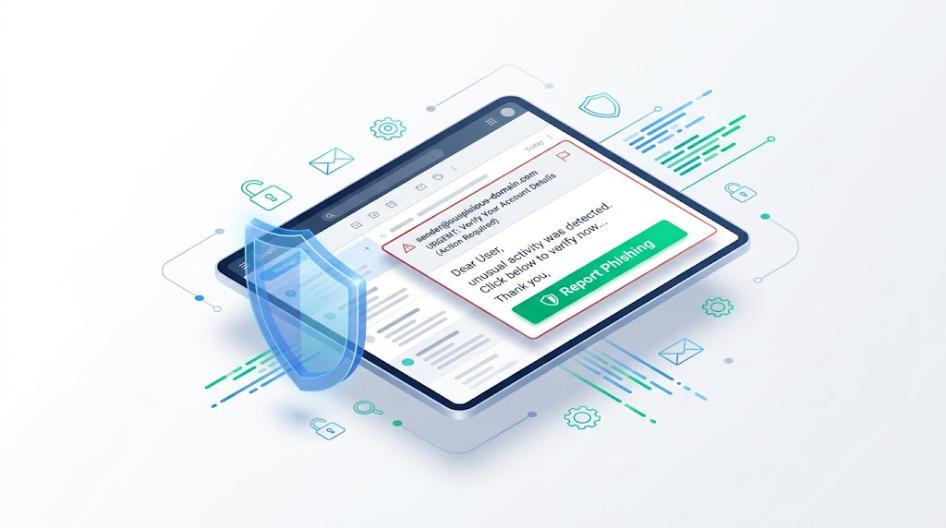
Even the best-trained employee may not report a suspicious message if reporting it requires opening a ticket, copying the email, finding the security team's address, and explaining what happened.
Reduce the friction.
A phishing-reporting workflow should ideally allow employees to report suspicious messages with minimal effort from the email environment they already use.
The objective is to create a simple behavioral pattern:
See → Stop → Report
The faster that pattern becomes habitual, the more useful employees become as an early-warning sensor for the SOC.
8. Reward Vigilance, Not Just Perfect Scores
Security awareness programs become more effective when organizations reinforce good behavior.
Recognize employees who:
Report genuine malicious emails
Consistently identify simulation campaigns
Help colleagues recognize suspicious activity
Demonstrate rapid reporting behavior
Consider initiatives such as:
"Catch of the Month"
Department recognition
Security-awareness badges
Reporting leaderboards
Team-based challenges
The goal isn't to turn cybersecurity into a competition where employees are afraid of making mistakes.
It is to make secure behavior visible and socially valued.
When employees see reporting as something positive, security awareness becomes part of organizational culture rather than another annual compliance requirement.
9. Build a Continuous Phishing Defense Cycle
A phishing simulation should never be a once-a-year exercise.
A mature program follows a continuous cycle:
Discover → Simulate → Measure → Educate → Improve → Repeat
Start by establishing a baseline.
Then run targeted simulations, analyze employee behavior, provide just-in-time education, and use the results to design the next campaign.
Over time, the organization should see:
Lower susceptibility + higher reporting + faster response = stronger human resilience
Platforms such as Phishtop can help operationalize this cycle by bringing campaign management, simulation, measurement, and awareness activities into a more structured workflow.
The technology is useful—but the real objective is behavioral change.
Quick-Start Checklist
Use this checklist to begin building a stronger phishing-defense program:
Adopt a no-shame policy: Treat simulations as training exercises, not disciplinary tests.
Establish a baseline: Measure susceptibility and reporting behavior before setting improvement targets.
Segment campaigns: Give Finance, HR, executives, IT, and other teams scenarios relevant to their responsibilities.
Increase realism gradually: Progress from obvious phishing indicators to contextual social-engineering scenarios.
Make reporting simple: Give employees an easy way to report suspicious messages.
Measure more than clicks: Track reporting rate, time to report, and repeat interaction.
Provide immediate feedback: Turn simulation failures into short, actionable learning opportunities.
Reward good behavior: Recognize employees who identify and report threats.
Repeat continuously: Treat phishing simulation as an ongoing security program, not an annual event.
The Human Firewall Is Built Through Practice
The goal of phishing simulation isn't to create employees who are afraid to click.
It is to create employees who know when to stop, question, verify, and report.
Firewalls, endpoint security, identity controls, and email protection remain essential. But attackers only need one successful interaction to bypass many layers of technical defense.
A well-designed human firewall adds another layer.
When employees are given realistic practice, immediate feedback, simple reporting mechanisms, and a culture that rewards vigilance, security awareness moves beyond compliance.
It becomes part of the organization's defensive architecture.
Ready to test and strengthen your organization's human defense layer?
Explore how Phishtop can automate your phishing simulations, baseline reporting, and just-in-time security training with ease.