

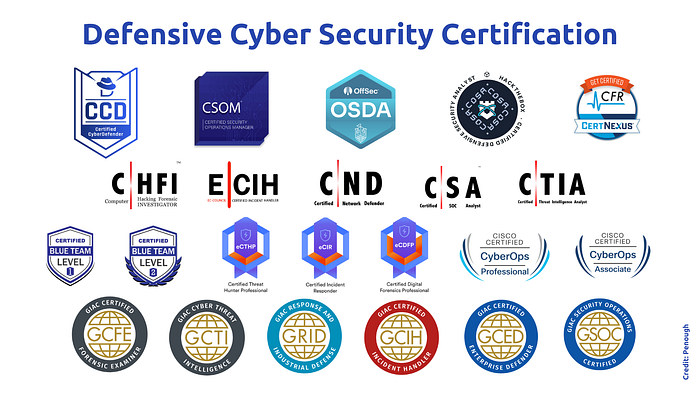
In today’s digital landscape, where cyber-attacks are becoming more frequent and sophisticated, businesses face significant challenges in protecting their critical data and infrastructure. Consequently, enterprises are prioritizing defensive security measures to prevent against these threats. In this context, defensive security certifications have become essential for professionals aiming to establish themselves in the field, as experience and knowledge are crucial in this industry. Let’s explore why certifications are vital in defensive security.
Demonstrated Expertise:
Proof of Knowledge: Certification indicates that an individual possesses an extensive understanding of defensive security concepts, methodologies, and best practices.
Validation of Skills: Defensive security certifications serve as a validation of an individual’s expertise in implementing and managing security measures to protect an organization’s digital assets.
Credibility and Trust:
Enhanced Credibility: Certified professionals are perceived as more credible and trustworthy by employers, clients, and colleagues, as they have undergone extensive training and assessment to obtain their certification.
Industry Recognition: Certifications from reputable institutions or organizations are recognized and respected across the industry, adding weight to an individual’s professional profile.
Career Advancement:
Competitive Advantage: In a competitive job market, having relevant certifications can set professionals apart from their peers and increase their chances of landing desirable roles in defensive security.
Career Growth: Certifications can open doors to new career opportunities and set the path for career advancement within an organization, leading to higher job satisfaction and financial rewards.
Keeping Pace with Evolving Threats:
Continual Learning: Maintaining certifications often requires ongoing training and remaining updated on the latest advancements in defensive security, ensuring that professionals remain relevant and proficient in their field.
Adaptability: Certified personnel are better equipped to adapt to the rapidly evolving cybersecurity world and proactively deal with emerging threats as well as vulnerabilities.
Compliance and Risk Management:
Regulatory Compliance: Certain certifications are associated with industry standards and laws, assisting organizations in demonstrating compliance with legal and regulatory obligations related to defensive security.
Risk Mitigation: Certified professionals are equipped to identify, assess, and mitigate security risks effectively, contributing to the overall resilience of an organization’s security posture.
Defensive certifications demonstrate ability, enhance credibility, enable professional advancement, encourage continual learning, and assist in regulatory compliance. Obtaining relevant qualifications is an important investment in a professional’s career, demonstrating their commitment to protecting sensitive digital assets from cyber threats. Several certifications have been designed to validate individual skills and understanding in developing and overseeing defensive security systems. These certifications not only demonstrate an individual’s capacity to secure digital assets but also give a clear path for professional advancement in the rapidly growing cybersecurity industry.
Let’s look at defensive cybersecurity certifications and the opportunities they provide for anyone wishing to distinguish themselves in this essential industry.
List of Certifications:
Certified CyberDefender (CCD)
CCD is a vendor-neutral, hands-on cybersecurity training and certification. It is designed to prepare the next generation of SOC analysts, security blue teams, threat hunters, and DFIR professionals. This training introduces you to real-world threats defenders experience in their networks and the tools used to defend against them. You will learn defense strategies, threat-hunting techniques, adversary detection, and how to investigate security intrusions and perform forensic analysis.
Source: CyberDefenders
CCD Price: $800
HTB Certified Defensive Security Analyst (HTB CDSA)
Certified Defensive Security Analyst (HTB CDSA) is a highly hands-on certification that assesses the candidates’ security analysis, SOC operations, and incident handling skills. HTB Certified Defensive Security Analyst (HTB CDSA) certification holders will possess technical competency in the security analysis, SOC operations, and incident handling domains at an intermediate level. They will be able to spot security incidents and identify avenues of detection that may not be immediately apparent from simply looking at the available data/evidence. They will also excel at thinking outside the box, correlating disparate pieces of data/evidence, and pivoting relentlessly to determine the maximum impact of an incident. Another skill they will bring is the creation of actionable security incident reports tailored for diverse audiences.
Source: HackTheBox
HTB CDSA Price: $490
OffSec Defense Analyst (OSDA)
Learn the foundations of cybersecurity defense with Foundational Security Operations and Defensive Analysis (SOC-200), a course designed for job roles such as Security Operations Center (SOC) Analysts and Threat Hunters. Learners gain hands-on experience with a SIEM, identifying and assessing a variety of live, end-to-end attacks against a number of different network architectures. Learners who complete the course and pass the exam earn the OffSec Defense Analyst (OSDA) certification, demonstrating their ability to detect and assess security incidents.
Source: OffSec
OSDA Price: $1,649
OffSec Threat Hunter (OSTH)
OffSec’s Foundational Threat Hunting (TH-200) equips cybersecurity professionals with the practical skills and knowledge needed to effectively detect and respond to threats. This course covers core threat hunting concepts, exploring the methodologies used by enterprises to track and mitigate adversaries. Key areas include understanding the threat actor landscape, with a focus on ransomware and Advanced Persistent Threats (APTs), and utilizing both network and endpoint Indicators of Compromise (IoCs) for proactive threat detection.
Source: OffSec
OSTH Price: $1,649
Cyber Defense Certified Professional (CDCP)
The CDCP is a practical application of the knowledge, tools, techniques, and procedures acquired through the Cyber Defense Analyst Program. This is accomplished through a battery of real-world security operations scenarios that students must overcome and articulate in a detailed report that includes the appropriate executive summary, findings, recommendations, and remediation steps along with applicable evidence. A holder of the CDCP has demonstrated the knowledge, skill, and practical application to work within a security operations team.
Source: Level Effect
CDCP Price: $499
Blue Team Level 1 (BTL1)
BTL1 is designed to train technical defenders who are capable of defending networks and responding to cyber incidents. Below are some examples of the skills and experience you will gain: Analysing and responding to phishing attacks, Performing forensics investigations to collect and analyse digital evidence, Using a SIEM platform to investigate malicious activity, Log and network traffic analysis including malware infections ,Conducting threat actor research, and much more!
Source: Security Blue Team
BTL1 Price: £399
Blue Team Level 2 (BTL2)
BTL2 is aimed at security professionals with 2–4 years experience in a practical role, but can be suitable for individuals with less experience provided they can commit to the intense training.
Source: Security Blue Team
BTL2 Price: £1,999
Certified Security Operations Manager (CSOM)
CSOM is designed to forge technical managers who already have experience and exposure to security operations. CSOM will develop you in both management principles and technical skills.
Source: Security Blue Team
CSOM Price: £1,999
Certified Threat Hunting Professional (eCTHPv2)
eCTHP is a professional-level certification that proves your threat hunting and threat identification capabilities. Students are tested through real-world scenarios modeled after cutting-edge malware that simulates corporate network vulnerabilities.
Source: INE
eCTHPv2 Price: $400
Certified Incident Responder (eCIR)
The Certified Incident Responder (eCIR) exam challenges cyber security professionals to solve complex Incident Handling & Response scenarios in order to become certified.
Source: INE
eCIR Price: $400
Certified Digital Forensics Professional (eCDFP)
eCDFP is an advanced digital forensics exam meant for senior-level Cybersecurity professionals. A successful certification allows digital forensics investigators to prove their technical digital forensics expertise.
Source: INE
eCDFP Price: $399
Practical Junior Security Analyst (PJSA)
The PJSA certification is a beginner-level security operations and incident response exam experience. The exam will assess a student’s ability to use analysis tools, interpret artifacts, and apply investigation methodologies to respond to incidents at a Tier 1 and Tier 2 level.
Source: TCM Security Academy
PJSA Price: $249
Certified Cyber Defence Analyst [CCDA]
In the digital era, swiftly identifying and investigating cyber threats — such as phishing, web-based, network-based, and host-centric attacks — is vital. Utilizing tools like incident response, network monitoring, SIEM, and FIM, alongside a solid grasp of the organization’s defense strategy, ensures effective threat management and response.
Source: CyberWarFare
CCDA Price: $149
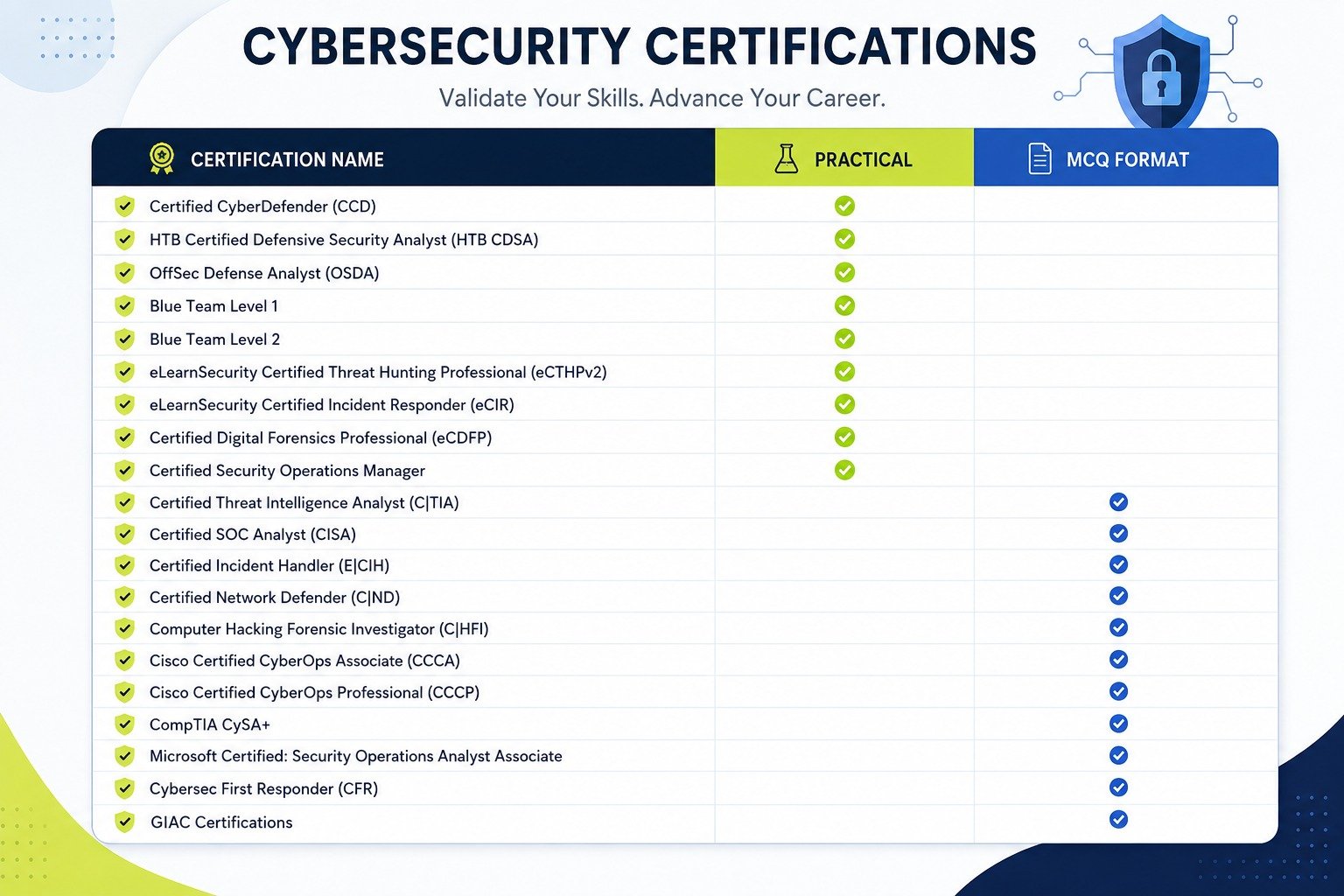
Here are the list of Multiple-Choice Question (MCQ) Certifications:
Certified Threat Intelligence Analyst (C|TIA)
Certified SOC Analyst (C|SA)
Certified Incident Handler (E|CIH)
Certified Network Defender (C|ND)
Computer Hacking Forensic Investigator (C|HFI)
Cisco Certified CyberOps Associate (CCCA)
Cisco Certified CyberOps Professional (CCCP)
CompTIA CySA+
Microsoft Certified: Security Operations Analyst Associate
Cybersec First Responder (CFR)
GIAC Certifictions