

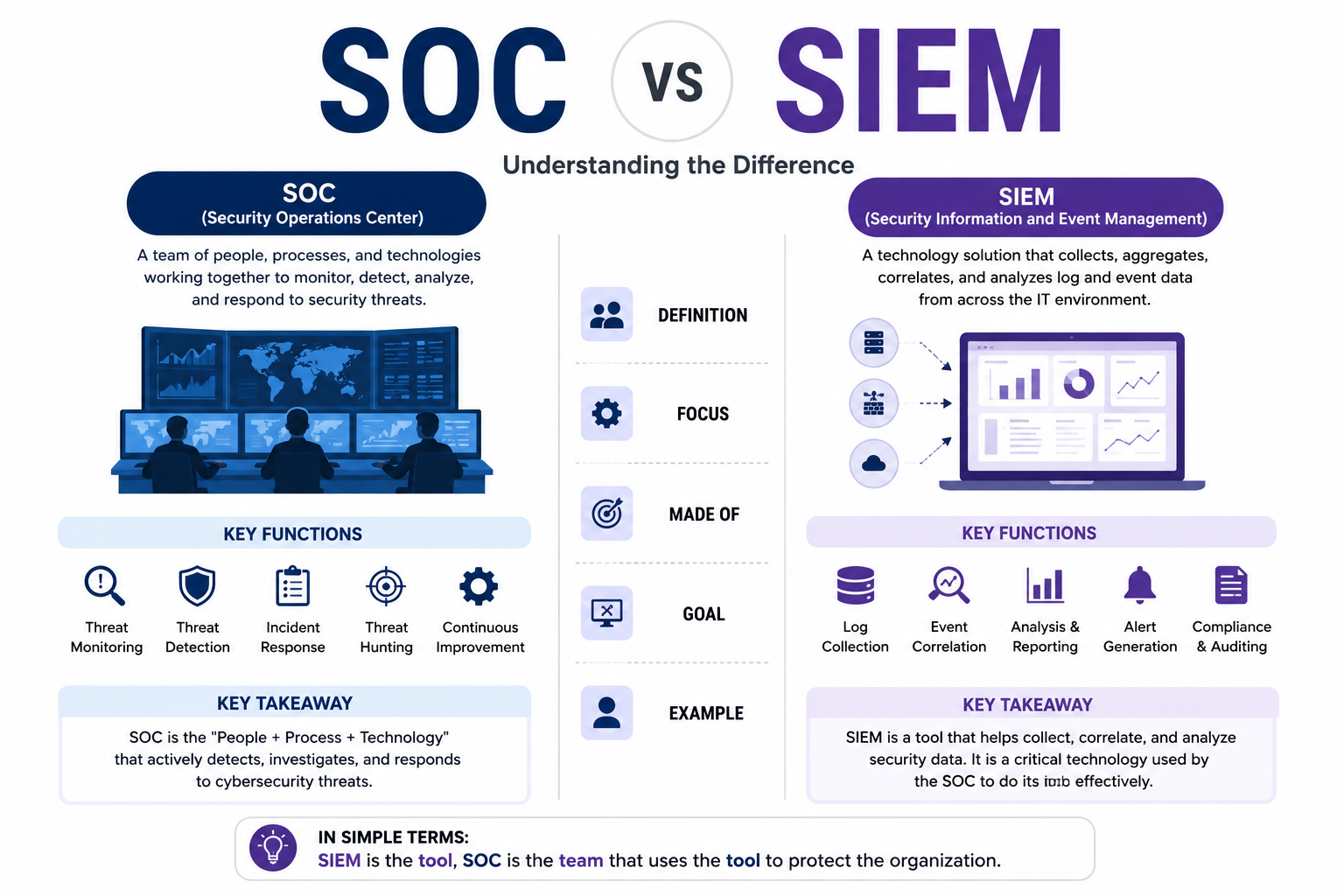
As cyber threats become more frequent and sophisticated, organizations need more than just security tools to stay protected. Effective cybersecurity requires the right combination of skilled security professionals, well-defined processes, and technologies that provide visibility into potential threats.
One of the most common misconceptions in defensive cybersecurity is that a Security Operations Center (SOC) and a Security Information and Event Management (SIEM) solution are the same thing. In reality, they serve very different purposes. A SOC is the team that monitors, investigates, and responds to security incidents, while a SIEM is the technology that collects, analyzes, and correlates security data to help that team detect threats.
Understanding the difference between SOC and SIEM is essential for building an effective security strategy. In this article, we'll explore how they differ, how they work together, and why both are critical to protecting modern organizations.
1. What is a SIEM? (The Analytical Engine)
What Does a SIEM Actually Do?
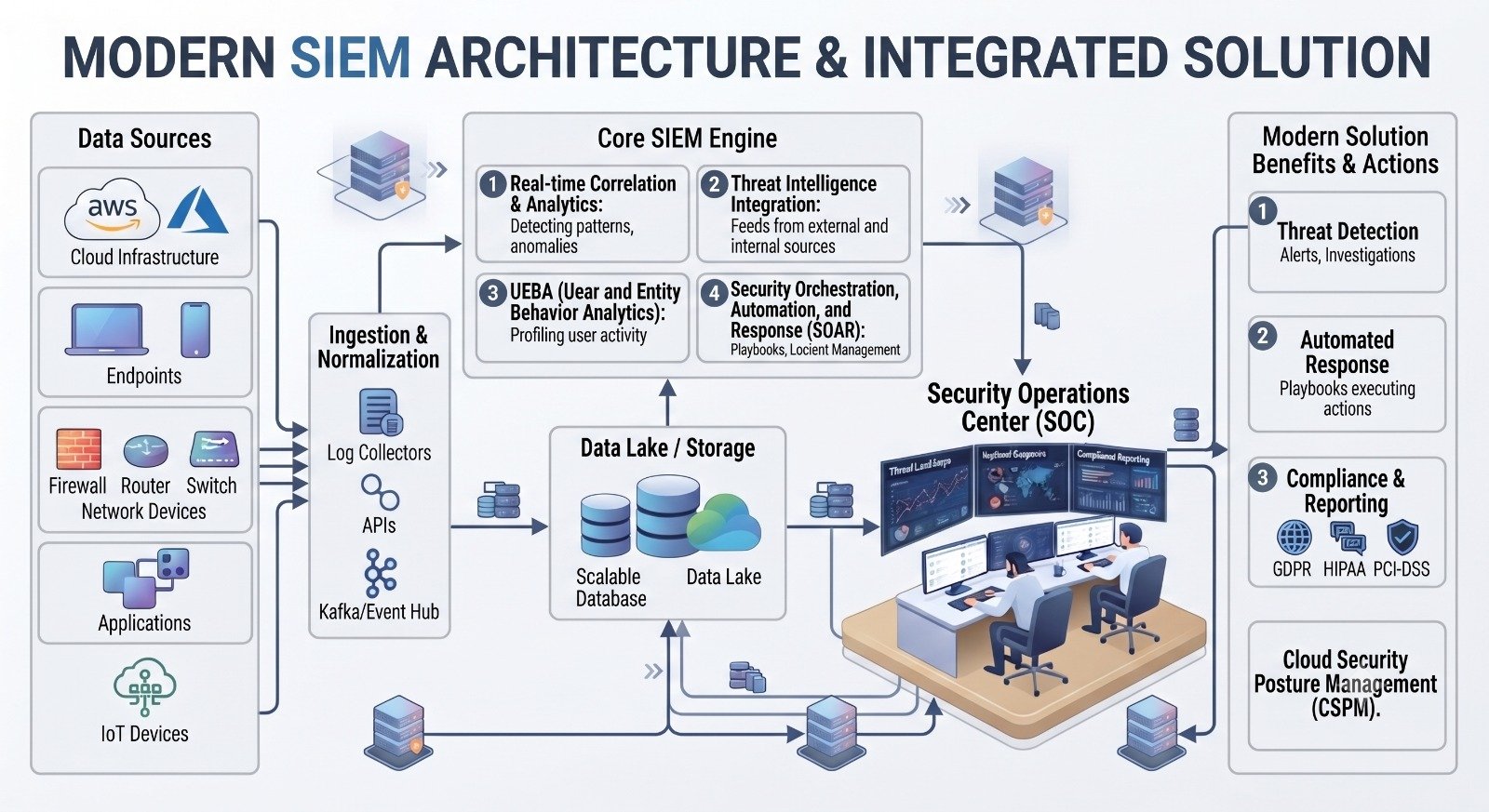
Think of a SIEM as the central monitoring system for your organization's digital environment. Every second, computers, servers, cloud services, applications, firewalls, and other devices generate thousands—even millions—of security logs. No human team can manually monitor all of that information.
A SIEM automatically collects, organizes, and analyzes these logs so security teams can quickly spot suspicious activity before it turns into a serious incident.
It does this through three key functions:
1. Collects and Organizes Logs
A SIEM gathers logs from different devices, applications, cloud platforms, and security tools. Since each system stores data in a different format, the SIEM converts everything into a common format, making it much easier to search, analyze, and investigate.
2. Connects the Dots
Instead of looking at each event separately, a SIEM analyzes multiple events together. For example, it might notice that a user logged in from an unusual country and, just moments later, started running suspicious PowerShell commands. Individually these events might not seem dangerous, but together they could indicate an active attack.
3. Alerts the Security Team
When the SIEM detects suspicious behavior or finds activity that matches known attack patterns or Indicators of Compromise (IOCs), it immediately generates an alert so the security team can investigate and respond before the threat escalates.
2. What is a SOC? (The Human Infrastructure)
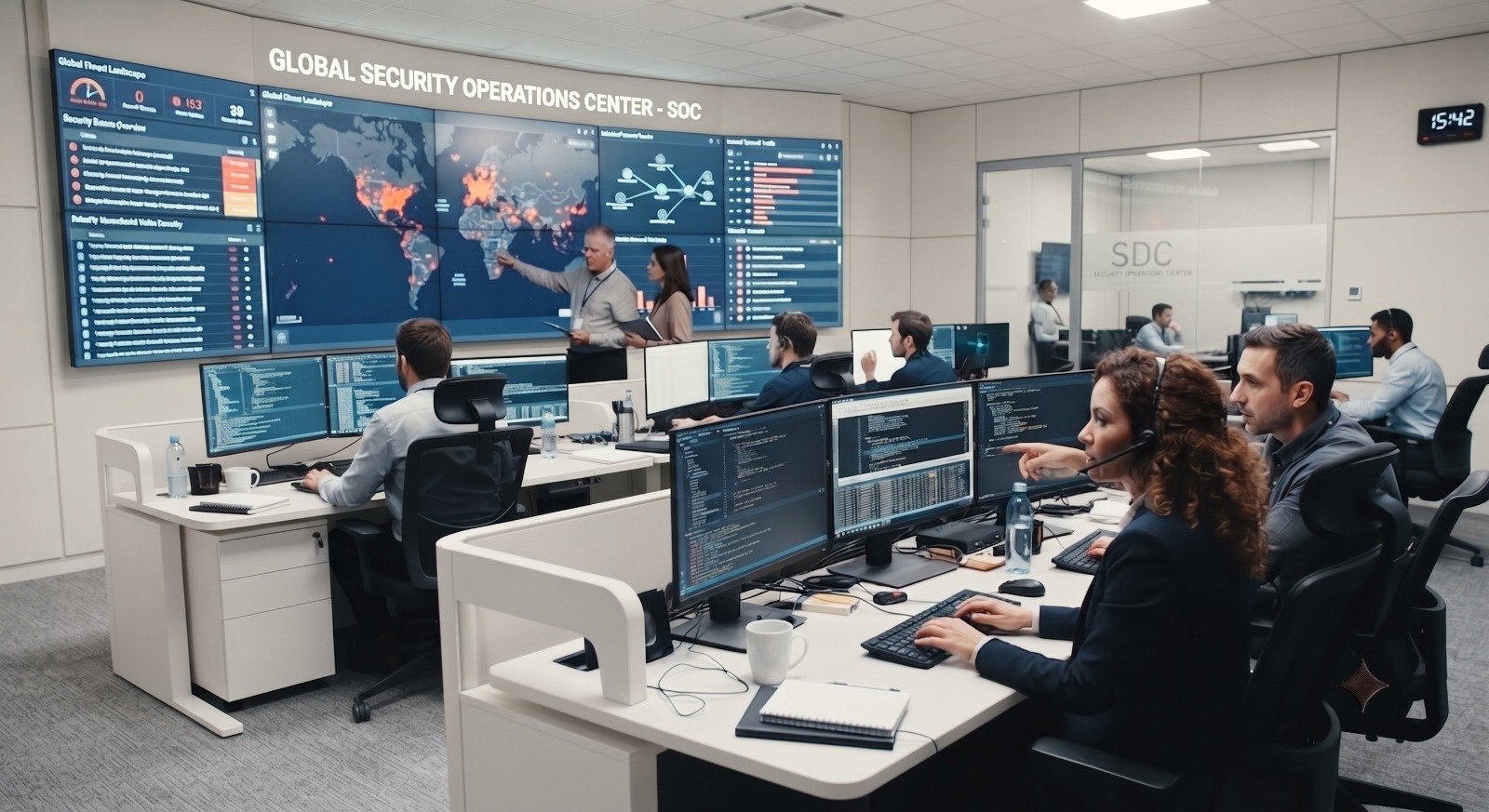
A Security Operations Center (SOC) is a centralized hub where cybersecurity experts work together using structured procedures and playbooks to monitor an organization's security posture and remediate problems quickly. While the SIEM gives visibility into what is happening, the SOC team uses that intelligence to decide what action to take next.
A typical mature SOC utilizes a tiered engineering architecture:
Tier 1 (Triage Analysts): These analysts serve as the first line of defense. They continuously monitor security alerts, review logs, filter out false positives, and escalate suspicious incidents for further investigation.
Tier 2 (Incident Responders / DFIR): At this stage, analysts investigate confirmed security incidents to determine how an attack occurred, identify affected systems, collect digital evidence, and work to contain the threat before it spreads.
Tier 3 (Threat Hunters & Engineers): At this level, analysts proactively search through security data, system logs, and network activity to uncover advanced threats that automated tools may miss. They also improve detection rules, fine-tune security tools, and strengthen the organization's overall security defenses.
The primary goal of a SOC is to continuously monitor for threats, investigate security incidents, respond quickly to attacks, and help the organization recover while strengthening its overall security.
Head-to-Head: Engineering vs. Execution
To optimize security investments, leadership must recognize where the technology ends and the human resource begins:
Operational Feature | SIEM (The Technology) | SOC (The People & Process) |
Core Classification | Software Platform / Collection Engine | Human Operations Framework / Team |
Primary Functional Scope | Log collection, log parsing, and correlation. | Validation, threat containment, and active forensics. |
Execution Vector | Algorithmic analysis and automated rulesets. | Cognitive reasoning, contextual investigation, and remediation. |
Remediation Capability | Identifies indicators of compromise but cannot isolate threats natively. | Eradicates active malware, revokes sessions, and patches perimeters. |
The Strategic Synergism: How They Collaborate
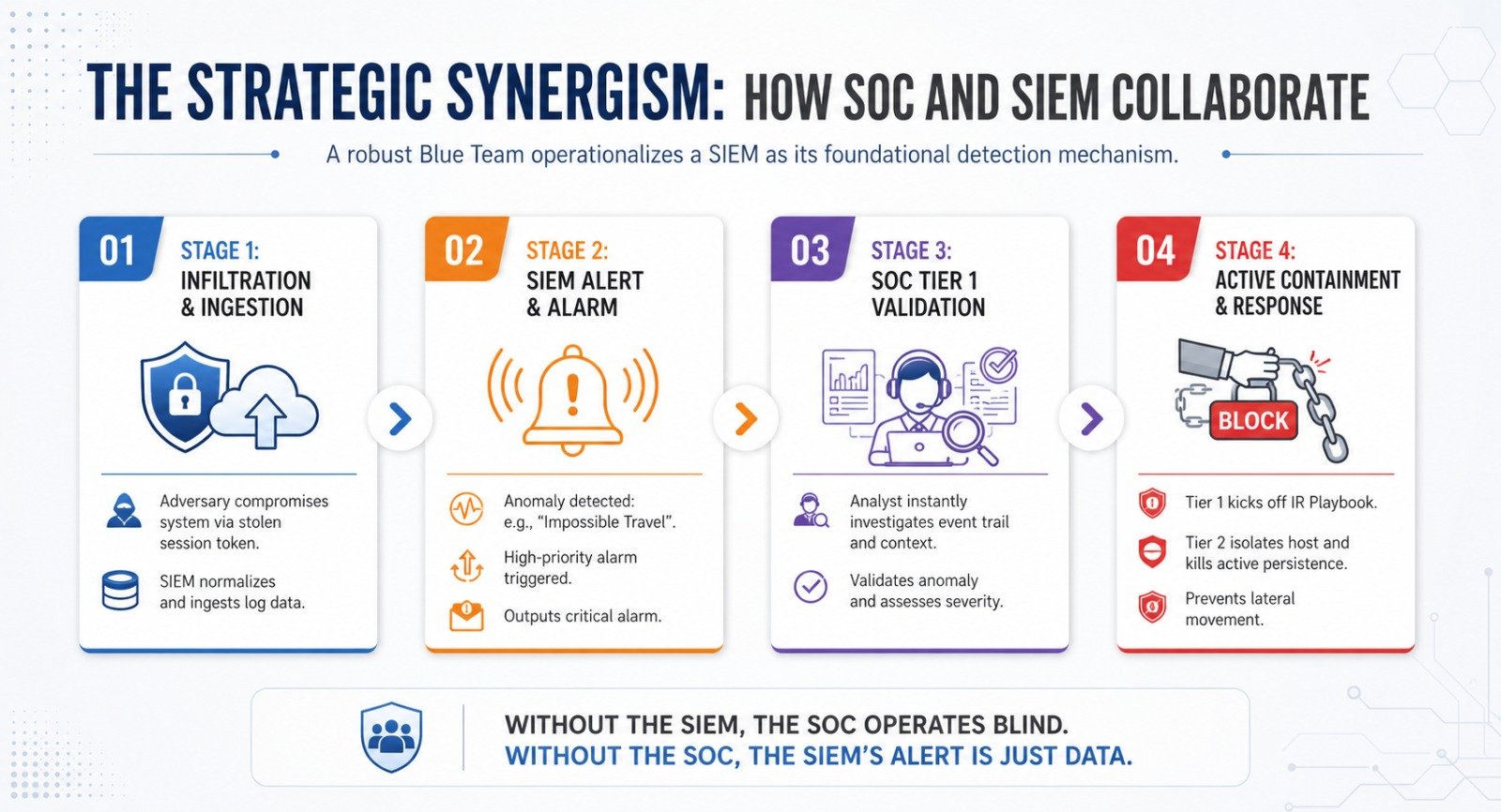
Defensive architecture is never a choice of choosing a SOC versus a SIEM. Instead, a robust Blue Team operationalizes a SIEM as its foundational detection engine. Think of it this way: Without the SIEM, the SOC operates blind. Without the SOC, the SIEM’s critical alert becomes a useless footnote in a post-mortem audit report.
The Lifecycle of a Lightning-Fast Defense
When an attacker strikes, every millisecond counts. Here is how a modern, high-velocity operation turns the tables on intruders:
Stage 1: Infiltration & Ingestion
An adversary attempts to breach the perimeter using a sophisticated stolen session token or by exploiting an unpatched RCE vulnerability on an external-facing server. The game is on, but the defense is ready.
Stage 2: SIEM Alert & Alarm
The SIEM engine roars to life! It normalizes the incoming logs, correlates the anomalous privilege escalation with the unauthorized connection to a malicious IP, and instantly triggers a high-priority alert.
Stage 3: SOC Tier 1 Validation
An expert Tier 1 analyst jumps on the case with surgical precision. They investigate the event trail, validate the anomaly, filter out environmental noise, and immediately escalate it to Tier 2.
Stage 4: Active Containment & Response
This is where the battle is won. Following a strict incident response playbook, Tier 2 responders ruthlessly isolate the compromised host. Lateral movement is stopped cold, active persistence is killed, and a potential ransomware catastrophe is averted.
Avoiding Critical Architecture Blunders
When organizations fail to understand the symbiotic relationship between a SOC and a SIEM, they inevitably fall into destructive operational traps. Leadership must actively avoid these four critical blunders:
The Tool-Centric Security Deficit (The Illusion of Tech): Organizations frequently allocate their entire defensive budget to licensing top-tier enterprise SIEM platforms, assuming tech solves everything. When a breach occurs, it is rarely a failure of the tool to alert, but a failure of human presence to respond. A SIEM is an engine, not an autonomous driver.
Infrastructure Burnout (Alert Fatigue): Forcing generic system administrators or an IT helpdesk team to monitor a fully integrated SIEM is a recipe for failure. A SIEM scales up noise quickly. Without dedicated SOC analysts trained to parse security context, your critical staff will experience alert fatigue, leading to missed anomalies.
The "Set-It-and-Forget-It" Stagnation: Treating SIEM deployment as a one-time project is a major mistake. Cyber threats evolve daily. Without a dedicated team constantly updating rules based on new threat intelligence, the SIEM quickly becomes a costly, blind dashboard that fails to detect modern, zero-day exploits.
Data Over-Ingestion & Data Swamps: Dumping every single log source into the SIEM without a strategic plan drives up licensing costs and creates massive noise. On the flip side, missing key data sources creates blindspots. A mature SOC ensures that only high-fidelity, high-value logs are ingested.
Technical Roadmap Moving Forward
To transition from architectural blunders to operational resilience, organizations must deploy a structured strategy that scales technology alongside human capability. The roadmap to maturity focuses on three immediate pillars:
Ingestion Optimization (Smart Logging): Before sending every log source to your SIEM, establish a clear data collection strategy. Focus on high-value security data, such as cloud identity provider logs, endpoint detection and response (EDR) logs, and core network security logs. Collecting everything without a plan creates unnecessary noise and increases costs, while collecting the right data helps your SIEM detect threats more accurately.
Tiered Human Scaling (The Hybrid SOC Model): If building a 24/7/365 internal SOC is budget-prohibitive, do not force your IT helpdesk to take the burden. Instead, leverage a Co-Managed SOC or MDR (Managed Detection and Response) model. Let an external partner handle Tier 1 triage overnight, while keeping Tier 2 incident response and contextual business decisions internal.
Continuous Tuning & Threat Hunting: A SIEM requires continuous development. Establish a routine where security engineers map existing detection rules directly against the MITRE ATT&CK framework. As threat actors update their tactics, your SOC team must proactively update the SIEM's correlation engine to look for those specific behaviors.
Streamlining Blue Team Operations with Penough
Building an in-house defensive infrastructure from scratch demands massive capital, round-the-clock staffing, and continuous engineering calibration. This is where Penough steps in as a strategic Blue Team partner, delivering enterprise-grade defensive capabilities that seamlessly bridge the gap between advanced technology and expert human execution.
Instead of letting organizations fall into the traps of alert fatigue or tool-centric deficits, Penough offers a managed defensive ecosystem designed to secure your digital perimeter:
24/7 Managed Detection & Response (MDR): Penough provides the active human infrastructure your organization needs. Their dedicated defense analysts continuously monitor your environment, ensuring that critical anomalies are validated and triaged in real time, effectively eliminating environmental noise and alert fatigue.
High-Fidelity SIEM Deployment & Management: Penough takes the complexity out of SIEM operations. They orchestrate log aggregation and real-time event correlation across your network, cloud, and endpoints—turning a chaotic "data swamp" into an intelligent threat detection engine.
Continuous Rule Tuning & Threat Hunting: Rather than treating defense as a static, "set-it-and-forget-it" appliance, Penough security engineers proactively update detection rules against emerging global threat intelligence, uncovering sophisticated threat actors that attempt to evade automated defenses.
Rapid Incident Containment Support: When a true positive threat is flagged, Penough defensive team assists with immediate playbook execution—helping your organization isolate compromised hosts, revoke malicious tokens, and contain the blast radius before damage spreads.
Conclusion: The Cyber Resilience Formula
In modern defensive cybersecurity, the debate is never SOC vs. SIEM—it is about synchronization. Technology without human intelligence is blind; human intelligence without technology is overwhelmed.
Cyber Resilience = SIEM (Visibility & Speed) x SOC (Context & Action)
As you design or upgrade your organization's security posture, remember this simple truth: SIEM is your radar, but the SOC is your pilot. Investing heavily in the most expensive radar in the world won’t save the aircraft if the cockpit is empty when a storm hits. True enterprise security is achieved only when high-fidelity machine data meets decisive human execution.