


Imagine a company discovering that its customers' personal information is being exposed.
The security team starts investigating. They check system logs, review user activities, and look for unusual network connections. But something doesn't make sense. Everything appears normal.
There are no obvious warning signs, suspicious login attempts, or clear signs of an attack.
So, what happens next?
For an incident response engineer, this is where the real investigation begins.
Cybersecurity is not just about preventing hackers from entering a system. Sometimes, it means understanding how an attacker thinks, finding hidden signs of suspicious activity, and connecting small pieces of evidence to understand what actually happened.
This is the kind of work Amit Kumar Biswas, an Incident Response Engineer, discussed in Episode 3 of Ping The Guest, hosted by Md. Nazrul Islam of Penough Ltd.
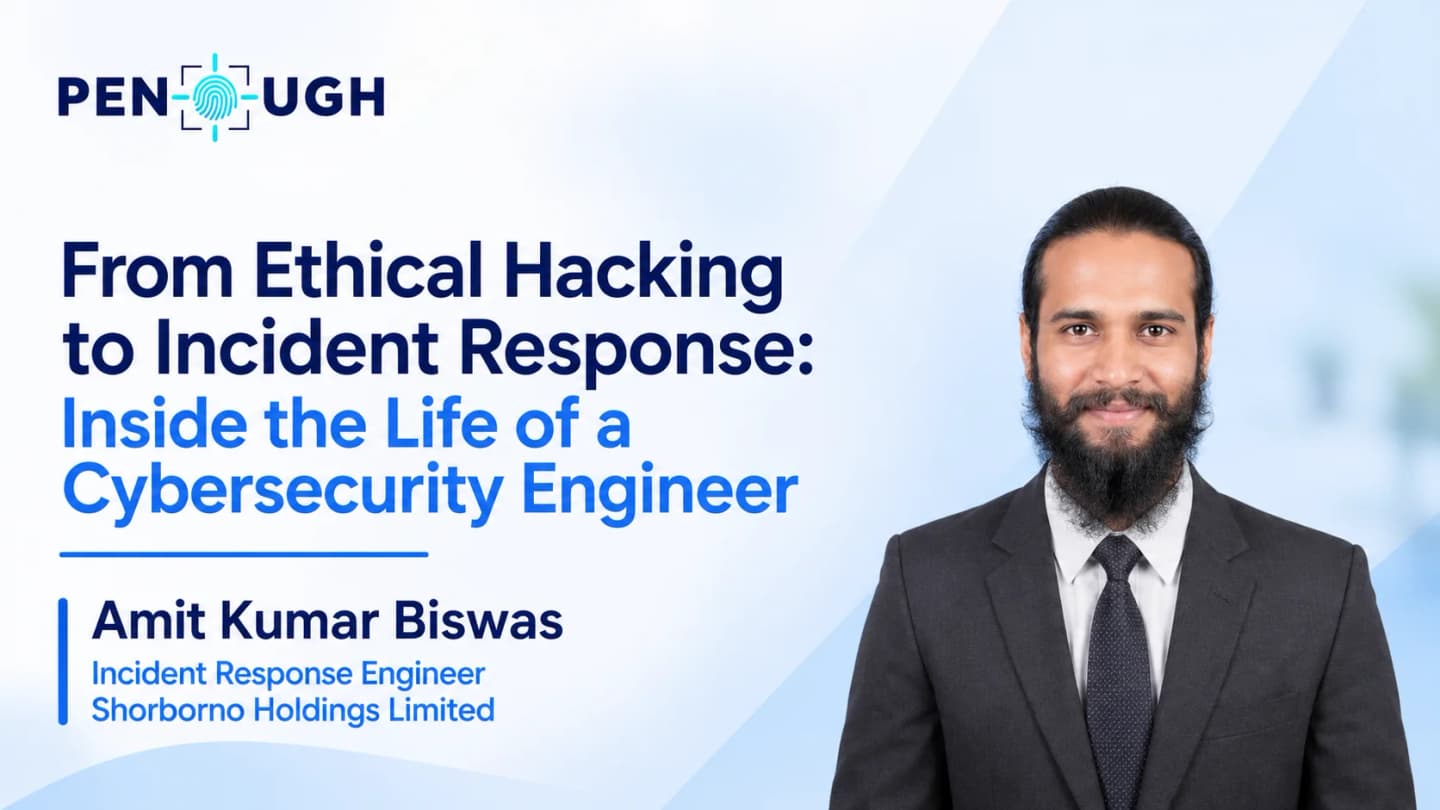
But Amit's journey into cybersecurity did not begin with an advanced technical degree or a job at a security company.
It started with curiosity, a few friends, and a simple Google search.
During the conversation, he shared how he moved from offensive security to defensive security, explained how companies investigate cyberattacks, and discussed some of the challenges facing Bangladesh's cybersecurity industry.
His experience offers valuable lessons for students, beginners, cybersecurity professionals, and organizations that want to protect their digital systems.
Let's explore his journey.
1. How a Simple Google Search Started a Cybersecurity Career
Amit's interest in cybersecurity began in 2016, during a gap year after his SSC examinations.
At the time, he was learning C programming and had started hearing about hacking through conversations with friends.
He became curious about how computers could be hacked.
Without formal cybersecurity training or an experienced mentor, he turned to Google and searched for something many beginners might have searched for:
"How to hack someone's computer."
That simple search became the starting point of a much bigger journey.
He gradually started learning about offensive security, particularly web application penetration testing.
In simple terms, web application penetration testing involves checking websites and web applications for security weaknesses before attackers can exploit them.
He became interested in questions such as:
How can someone find weaknesses in a website?
How do attackers gain unauthorized access?
How can an attacker increase their level of access after entering a system?
What happens when a website has a serious security vulnerability?
One topic that particularly interested him was Remote Code Execution (RCE).
RCE is a security vulnerability that can allow an attacker to execute commands or code on another system. Depending on the weakness, this could give the attacker control over important parts of an application or server.
But as Amit gained more experience, his interests started changing.
He wanted to understand more than just how attackers break into systems.
He wanted to know how security teams detect them.
That curiosity eventually changed the direction of his career.
2. Offensive Security vs. Defensive Security: Why Understanding Hackers Matters
There are two important sides to cybersecurity: offensive security and defensive security.
Although they have different responsibilities, both play an important role in protecting organizations.
Offensive security focuses on finding security weaknesses by thinking and testing like an attacker.
For example, penetration testers examine websites, applications, and networks to discover vulnerabilities before malicious hackers find them.
Defensive security, on the other hand, focuses on protecting systems, monitoring activities, identifying threats, and responding when something goes wrong.
Amit initially started with offensive security.
While testing websites and applications, he frequently encountered security technologies such as firewalls and Web Application Firewalls (WAFs).
A WAF helps protect websites by monitoring incoming web traffic and blocking requests that appear malicious.
Instead of simply trying to get past these security controls, Amit became interested in understanding how they worked.
Why was a particular request blocked?
What made the security system consider it suspicious?
How could it recognize potentially dangerous activity?
These questions gradually introduced him to security monitoring, log analysis, and Endpoint Detection and Response (EDR) solutions.
Eventually, he moved into incident response.
Why Does Understanding Attackers Help Defenders?
Imagine a security analyst investigating an unusual connection from an employee's computer.
An analyst who understands offensive security may recognize techniques commonly used by attackers.
They may know which processes, network connections, login activities, or system events deserve closer attention.
This makes the investigation more focused.
Instead of checking everything without a clear direction, they have a better understanding of what might have happened.
This is one reason Amit encourages beginners interested in defensive security to build a foundation in offensive security.
However, practical learning should always happen in authorized environments.
Platforms such as TryHackMe and Hack The Box provide safe learning environments where students can practice cybersecurity skills without testing systems they do not own or have permission to assess.
You do not have to become an attacker to protect systems, but understanding how attackers operate can make you a better defender.
3. What Tools Do Incident Response Engineers Use?
Learning cybersecurity at home is different from working inside a company's Security Operations Center (SOC).
At home, students may experiment with individual tools and small practice environments.
In a corporate environment, security teams often use several platforms together to monitor computers, collect system information, identify suspicious activities, and investigate possible attacks.
During the podcast, Amit discussed several technologies used in professional security environments.
Endpoint Detection and Response (EDR)
Endpoint Detection and Response (EDR) tools monitor computers, servers, and other devices connected to an organization's network.
They help security teams identify suspicious activities, malicious files, unusual programs, and potentially compromised devices.
Some examples discussed by Amit include:
CrowdStrike Falcon
Microsoft Defender
Imagine an employee accidentally downloading a malicious file.
An EDR solution may help the security team investigate what happened, identify suspicious programs running on the computer, and examine other activities that could indicate a compromise.
This gives investigators valuable information about what happened on an individual device.
Security Information and Event Management (SIEM)
Security Information and Event Management (SIEM) platforms collect and analyze security records from different systems.
To understand why this matters, imagine a company with hundreds of employees.
Every day, its systems generate thousands of records, including:
Employee login activities.
Firewall events.
Server activities.
Application records.
Failed login attempts.
Checking all these records individually would take a considerable amount of time.
A SIEM platform brings this information together and helps security teams identify unusual patterns.
For example, if someone repeatedly tries to access an employee account from unusual locations, the system may generate an alert for further investigation.
Amit mentioned several enterprise security solutions:
Splunk
IBM QRadar
CrowdStrike Falcon XDR
He also highlighted Wazuh, an open-source security monitoring platform that students and organizations can use to build their own monitoring environments.
These platforms support different security functions, including log analysis, threat detection, investigation, and response. While SIEM platforms primarily collect and analyze security data from multiple sources, XDR solutions correlate security signals across different environments to support detection and investigation.
Cyber Threat Intelligence: Understanding Current Threats
Cybercriminals constantly change their methods.
They may use new websites, IP addresses, servers, and malicious files to avoid detection.
This is where Cyber Threat Intelligence (CTI) becomes useful.
Threat intelligence involves collecting and analyzing information about cyber threats, including known malicious IP addresses, suspicious domains, malware, and attacker activities.
For example, imagine a security analyst discovers an unusual IP address communicating with a company server.
By checking available threat intelligence, the analyst may discover that the same IP address has previously been associated with malicious activities.
This information can help the security team understand the potential risk and decide what to investigate next.
Amit explained how threat intelligence helps SOC teams recognize suspicious activities and investigate potential threats more effectively.
Other Security Technologies Discussed
The conversation also covered several other security technologies:
Data Loss Prevention (DLP): Helps organizations monitor and control how sensitive information is shared or transferred.
Threat Prevention: Helps identify and block potentially harmful activities before they cause damage.
Managed Detection and Response (MDR): Provides security monitoring and investigation through a managed security service.
Stellar Cyber: A security platform discussed during the conversation.
Each technology has a different purpose, but they work toward a common goal: helping organizations identify threats, protect their systems, and respond to security incidents.
Are Default Windows Logs Enough for an Investigation?
Not always.
Windows records many system activities through its built-in logging features. However, these records may not contain all the information needed for a detailed security investigation.
An incident response engineer may need to understand:
Which programs were executed.
What network connections were created.
Which files were modified.
What suspicious activities occurred on the device.
Advanced EDR solutions can collect additional information, known as telemetry, that helps investigators understand what happened.
This is important because an investigation depends heavily on the quality and availability of evidence.
How Can Students Practice These Tools?
Enterprise security tools can be expensive, especially for individual learners.
Amit recommended exploring Wazuh as a practical starting point.
Students can install it in a home lab and experiment with collecting system logs, generating security alerts, and investigating unusual activities.
This is a useful way to understand how security monitoring works in real environments.
For anyone interested in SOC operations or incident response, learning to read and investigate system logs is an important first step.
4. Inside a Real Investigation: How a Hidden Data Leak Was Discovered
One of the most interesting parts of the podcast was Amit's experience investigating a customer data leak.
A customer reported that their information was being exposed.
However, the security team could not immediately identify how the attacker was accessing or extracting the data.
For approximately one and a half days, Amit and his team investigated the available logs.
They reviewed user activities and searched for anything unusual.
But there was a problem.
Everything appeared to be normal user activity.
The attacker was using application activity that did not immediately look suspicious. As a result, identifying the source of the data leak became difficult.
When Checking Logs Was Not Enough
After spending considerable time reviewing the available information, Amit decided to approach the problem differently.
He used his offensive security knowledge to examine the application's features and how they handled requests.
During testing, he identified a feature affected by Server-Side Request Forgery (SSRF).
SSRF is a security vulnerability that occurs when an application can be manipulated into sending requests to unintended destinations.
In some situations, attackers can abuse this weakness to access internal services or make requests to external systems.
During this investigation, Amit used his discovery to identify an IP address associated with the attacker's infrastructure.
The team then returned to the logs and searched for activities connected to that IP address.
This time, they found clearer evidence.
They identified that the attacker was abusing the vulnerable application feature to repeatedly extract customer data.
What Happened Next?
After identifying the vulnerable feature, the SOC team coordinated with the Red Team.
The Red Team investigated the weakness in greater detail and worked toward identifying and fixing the underlying security issue.
This incident demonstrates that responding to a cyberattack involves much more than checking security alerts.
It requires several activities:
Understanding the application: Learning how the affected system works.
Examining evidence: Reviewing available logs and system activities.
Understanding attack techniques: Recognizing how attackers may be exploiting the application.
Identifying suspicious infrastructure: Finding IP addresses or other indicators connected to the attack.
Working with other teams: Coordinating with security professionals responsible for further testing and remediation.
Fixing the weakness: Helping the organization prevent the same vulnerability from being exploited again.
Sometimes, the answer is not visible in the logs until investigators understand how an attacker is using the application.
How Can Organizations Improve Their Incident Response Capabilities?
Amit's experience highlights an important lesson: organizations need to prepare for attacks before they happen.
They should identify security weaknesses, monitor their systems, maintain useful records, and have a plan for investigating suspicious activities.
This requires a combination of preventive security measures and incident response capabilities.
Penough provides cybersecurity services that help organizations address different parts of this process:
Security Operations Center (SOC): Monitoring systems and investigating suspicious activities.
Digital Forensics and Incident Response (DFIR): Investigating security incidents, examining digital evidence, and supporting incident response.
Vulnerability Assessment and Penetration Testing (VAPT): Finding security weaknesses through controlled testing.
Red Teaming: Testing an organization's security by simulating realistic attack scenarios.
Threat Hunting and Malware Analysis: Investigating suspicious activities, potential threats, and malicious files.
Network Configuration Review and Penetration Testing: Examining network configurations and identifying potential security weaknesses.
These services support different stages of cybersecurity, from finding vulnerabilities before an attack to investigating incidents after they occur.
Explore Penough's Cybersecurity Services and Incident Response and DFIR Capabilities.
5. Threat Hunting: Tracking Phishing Campaigns Through Telegram
Phishing is one of the common ways cybercriminals trick people into sharing sensitive information.
A phishing website may look almost identical to a legitimate login page.
When someone enters their username and password, that information may be sent directly to the attacker.
But how do attackers collect this information?
During the podcast, Amit discussed how some phishing campaigns use Telegram bots to automatically collect information from victims.
A Telegram bot is an automated program that can receive and send messages through Telegram.
Attackers can configure phishing websites to send collected information to these bots.
Depending on the campaign, the information may include:
Victim IP addresses.
Location-related information.
Visitor details.
Stolen login credentials.
In some poorly secured implementations, attackers may also expose sensitive bot configuration details inside the website's frontend JavaScript files.
How Does Threat Hunting Help Identify These Campaigns?
Amit discussed using a tool to identify exposed Telegram bot tokens and chat IDs associated with malicious websites.
A bot token is a credential that allows a program to communicate with a Telegram bot. A chat ID identifies the destination where messages are sent.
If these details are exposed, investigators may be able to use them as clues to understand how a phishing campaign operates.
By examining this information, security researchers can gather evidence about the infrastructure behind malicious websites.
This is an example of proactive threat hunting.
Instead of waiting for an organization to report an attack or for a security system to generate an alert, threat hunters actively search for signs of malicious activity.
Amit described this approach as "Hunting the Hunter."
The broader objective is to identify malicious infrastructure, report abuse through appropriate channels, and help reduce the risk of further victims being targeted.
This example also shows why knowledge of Cyber Threat Intelligence and Open-Source Intelligence (OSINT) can be valuable for defensive security professionals.
How Can Organizations Improve Threat Intelligence and Phishing Awareness?
Identifying malicious websites and infrastructure is only one part of the challenge.
Organizations must also understand how attackers target their employees.
A single employee clicking a fraudulent link or entering credentials into a fake website can create serious security risks.
Penough offers several products that address related security challenges:
Surveiller: Helps organizations monitor their external attack surface, identify exposed assets, and track relevant threat intelligence.
PhishTop: A phishing simulation and security awareness platform that helps organizations test employee responses to phishing scenarios and identify where additional training is needed.
BugValluk (PenOps): Supports continuous penetration testing workflows, helping security teams identify vulnerabilities, track fixes, and retest security issues.
These products serve different purposes. They are not replacements for incident response, but they can help organizations improve security visibility, identify weaknesses, and build better security awareness.
Explore Surveiller, PhishTop, and BugValluk (PenOps).
6. Live Demonstration: Testing Web Security with Cloudflare Protection
Another interesting part of the podcast focused on web application security testing.
Many websites use services such as Cloudflare to protect their infrastructure from malicious traffic, automated requests, and other online threats.
These protections can sometimes affect legitimate security testing.
During the podcast, Amit demonstrated how security testers may encounter Cloudflare's bot protection while testing a website using tools such as Burp Suite.
He also discussed using MITM Proxy, a tool that allows testers to inspect and analyze network traffic between applications and servers.
For more advanced testing, he demonstrated how traffic could be routed between MITM Proxy and Burp Suite using an upstream proxy configuration.
This allows testers to examine how requests and responses move between different tools.
What Can Students Learn From This Demonstration?
The demonstration highlights an important part of web application security testing.
Security professionals need to understand how websites, proxies, HTTP requests, and security protections interact.
They also need to understand how to test these systems in authorized environments.
Bypassing a security control during an authorized test does not automatically mean that the protection is ineffective.
The purpose of testing is to understand how an application behaves under different conditions and identify weaknesses that need improvement.
For beginners, the best starting point is to understand:
How HTTP and HTTPS work.
How web requests and responses are structured.
How proxy tools operate.
How browser traffic reaches a web server.
How web application security controls work.
These fundamentals make advanced security testing easier to understand.
7. Why Missing Application Logs Make Cybersecurity Investigations Difficult in Bangladesh
One of the most important discussions in the podcast focused on a problem that often receives less attention than firewalls or antivirus software:
Insufficient application logging.
According to Amit, many locally developed applications do not maintain proper records of important user activities.
Developers may focus mainly on making an application's features work. However, they sometimes overlook the importance of recording what users and administrators do inside the system.
This becomes a serious problem when a security incident occurs.
What Are Application Audit Logs?
Application audit logs are records of important activities performed within a software application.
Think of them as a history of what happened inside a system.
Depending on the application, these records may include:
User login and logout activities.
Changes to account permissions.
Updates to important account information.
Access to sensitive records.
Actions performed by administrators.
Failed login attempts.
Changes to important application settings.
These records help organizations understand who performed an action, when it happened, and what changed.
What Happens When These Logs Are Missing?
Imagine an attacker gaining unauthorized access to a customer's account.
The organization discovers suspicious activity several days later and starts investigating.
But there is a problem: the application does not maintain sufficient records of user activities.
Now the security team may struggle to answer some basic questions:
Which account was accessed?
What information did the attacker view?
When did the suspicious activity begin?
What actions were performed?
How much information was exposed?
Without reliable records, reconstructing the incident becomes much harder.
Amit also highlighted the challenges of obtaining relevant historical information from external service providers when the necessary records are unavailable.
This creates additional difficulties for investigators.
Security Should Begin During Software Development
Logging should not be treated as an optional feature added after an application is completed.
It should be considered from the beginning of the software development process.
Developers and organizations should plan for:
Application audit logging: Recording important user and system activities.
Centralized log collection: Bringing records from different systems into one place.
Secure log storage: Protecting records from unauthorized access.
Access controls: Ensuring only authorized people can view or manage logs.
Retention policies: Deciding how long important records should be stored.
Monitoring and alerting: Identifying unusual activities through automated monitoring.
Log protection: Preventing unauthorized changes or deletion of records.
For organizations handling customer information, these practices can make a significant difference during a security investigation.
A system that cannot explain what happened during an attack is much harder to protect.
Turning Security Gaps into Action
Amit's discussion highlights a wider challenge for organizations in Bangladesh.
Security cannot depend only on having antivirus software or a firewall.
Organizations also need to understand whether their applications record important activities, whether their networks are properly configured, and whether their security teams can investigate suspicious events.
A structured security assessment can help identify weaknesses in applications, networks, and existing security practices.
Penough's services, including VAPT, network configuration review, SOC, and DFIR, address different parts of this process.
Organizations can use these capabilities to evaluate their security posture and improve their ability to detect and respond to incidents.
8. Bangladesh's Data Privacy Challenge: Why Organizations Need Better Accountability
The podcast also raised broader concerns about personal data protection in Bangladesh.
Host Md. Nazrul Islam highlighted how valuable personal information has become and why individuals and organizations need to take data security more seriously.
Think about how much information people share with digital services every day.
Online shopping platforms collect customer details. Financial applications process transaction information. Social media platforms store personal information, and many online services maintain account credentials and contact details.
But collecting information also creates responsibility.
Organizations must understand:
What information are they collecting?
Why do they need it?
Where is it stored?
Who can access it?
How is it protected?
What happens if that information is exposed?
These are important questions for any organization handling personal information.
What Can Happen When Personal Data Is Not Protected?
Consider the growing problem of unsolicited marketing calls and suspicious messages.
When personal contact information is collected, shared, or exposed without appropriate safeguards, individuals may become targets of spam, scams, and phishing attempts.
For businesses, poor data protection can also result in:
Loss of customer trust.
Financial damage.
Disruption to business operations.
Legal or regulatory consequences.
Damage to the company's reputation.
A data breach can affect much more than a company's computer systems. It can also affect the people who trusted that organization with their information.
Bangladesh's Changing Data Protection Landscape
Bangladesh's data protection framework has developed through new legislation, including the Personal Data Protection Act, 2026 (Act No. 63 of 2026) and the Cyber Security Act, 2026 (Act No. 81 of 2026).
The Cyber Security Act was subsequently amended through the Cyber Security (Amendment) Act, 2026.
These developments make it increasingly important for organizations to understand their responsibilities regarding personal information, cybersecurity, and incident management.
However, having laws alone cannot prevent data breaches.
Organizations also need practical security controls, proper documentation, trained employees, and effective incident response plans.
They should know what information they hold, limit unnecessary access, maintain appropriate records, and prepare for potential security incidents.
Data protection is not just a legal responsibility. It is an important part of maintaining customer trust.
9. University vs. Industry
For students studying Computer Science and Engineering, a university degree provides an important foundation.
But cybersecurity is also a highly practical field.
Understanding networking concepts or programming languages is not the same as investigating a real security incident.
During the podcast, Amit discussed the difference between academic learning and the practical requirements of his professional career.
He explained that many university topics were not directly applicable to the day-to-day responsibilities of his job.
His experience highlights an important lesson for students:
Do not depend entirely on your university syllabus to prepare for a cybersecurity career.
You need to combine academic knowledge with practical experience.
A Practical Learning Roadmap for Aspiring Incident Response Engineers
Based on the discussion, beginners can follow a structured learning path.
Step 1: Learn Networking and Operating System Fundamentals
Start by understanding how computers communicate and how operating systems work.
Focus on:
TCP/IP and basic networking.
DNS.
HTTP and HTTPS.
Linux fundamentals.
Windows fundamentals.
Basic network security.
Step 2: Understand Offensive Security
Learn how common security vulnerabilities work.
Explore web application security, authentication weaknesses, common attack techniques, and penetration testing methods.
Practice only in authorized learning environments.
Step 3: Learn Log Analysis
Start understanding how computers and applications record activities.
Explore Windows Event Logs, login records, network events, and application logs.
Learn how to recognize unusual activities.
Step 4: Build a Home Security Lab
Set up Wazuh and experiment with collecting and analyzing security events.
Practice generating test events, understanding alerts, and investigating suspicious activities.
Step 5: Understand SIEM and EDR
Learn how SIEM platforms collect and analyze information from different systems.
Understand how EDR solutions monitor computers and help security teams investigate suspicious activities.
Step 6: Develop Threat Hunting Skills
Explore Cyber Threat Intelligence, OSINT, common attack techniques, and indicators of compromise.
Learn how to investigate suspicious IP addresses, domains, files, and network activities.
Step 7: Practice Incident Investigation
Do not stop after learning how to generate security alerts.
Learn how to investigate them.
Ask yourself:
What happened?
When did it happen?
Which system was affected?
How did the attacker gain access?
What evidence supports the investigation?
What should the organization do next?
These questions form the foundation of effective incident response.
Where Can Students Develop Practical Cybersecurity Skills?
Students can improve their knowledge through independent practice, home labs, technical communities, and structured learning programs.
The goal should be to understand how cybersecurity works in real situations rather than simply collecting certificates.
Penough Academy focuses on cybersecurity education and practical learning through courses such as:
DCS101
DCS201
CDCS
WAS101
These courses cover different areas of cybersecurity learning and provide opportunities for interested learners to explore the field through structured training.
For students who want to develop practical skills alongside their academic studies, exploring cybersecurity training opportunities can be a useful next step.
Learn more about Penough Academy.
10. Is Defensive Security a Good Career Choice in Bangladesh?
Cybersecurity is an evolving industry in Bangladesh.
As businesses increasingly depend on digital platforms, protecting applications, networks, customer information, and business operations is becoming more important.
Financial institutions, technology companies, and organizations handling sensitive information need professionals who can identify security threats and respond to incidents.
This creates opportunities in several areas:
Security Operations Center (SOC) Analysis.
Incident Response.
Threat Hunting.
Digital Forensics and Incident Response (DFIR).
Security Engineering.
Vulnerability Assessment and Penetration Testing (VAPT).
Cyber Threat Intelligence.
Amit believes defensive security has significant potential in Bangladesh, although the local industry is still developing.
For students and early-career professionals, this creates an opportunity to develop practical skills as the market continues to mature.
However, entering the cybersecurity industry requires more than collecting certificates.
A strong foundation in networking, operating systems, security tools, log analysis, and practical investigation can help candidates prepare for real-world responsibilities.
The most important thing is to keep learning, practice regularly, and develop the ability to solve actual security problems.
Final Thoughts: The Best Defenders Understand How Attacks Work
Amit Kumar Biswas's journey shows how a simple curiosity can lead to an entirely different career path.
He started by exploring hacking, became interested in understanding security controls, and eventually moved into investigating real-world cyberattacks.
His experience also highlights several important lessons for Bangladesh's cybersecurity community.
Organizations need better application logging. Security teams need access to reliable evidence. Developers must consider security during software development. And aspiring professionals need practical experience alongside their academic education.
Most importantly, cybersecurity is not just about using advanced tools.
It is about asking the right questions, understanding how systems behave, and knowing where to look when something goes wrong.
Sometimes, finding the source of a data breach takes more than a day of investigation.
Sometimes, the most important clue is hidden inside an application feature that everyone else overlooked.
That is the reality of incident response.
And that is why skilled defensive security professionals matter.
Watch the Full Episode of Ping The Guest
Want to hear Amit's complete story and see his technical demonstrations?
Watch Episode 3 of Ping The Guest, featuring Amit Kumar Biswas.
Ping The Guest is a Penough podcast series featuring cybersecurity professionals, industry experts, and practitioners who share their experiences, technical knowledge, and perspectives on the evolving cybersecurity landscape.
Stay connected with Penough for more cybersecurity insights, practical security knowledge, and conversations with industry professionals.