


Traditional awareness training fails because it measures completion, not behavior: one annual video, generic content, and no practice. Fix it with continuous, role-based, practical training, simulations with instant feedback, and metrics that track real behavior and reporting.
In This Guide
The Annual Ritual That Does Not Work
What Is Traditional Security Awareness Training?
7 Reasons It Fails
7 Signs Your Program Is Not Working
6 Fixes That Work
Traditional vs. Modern Training
How Technology Helps (and Its Limits)
FAQ, Bottom Line and Keep Reading
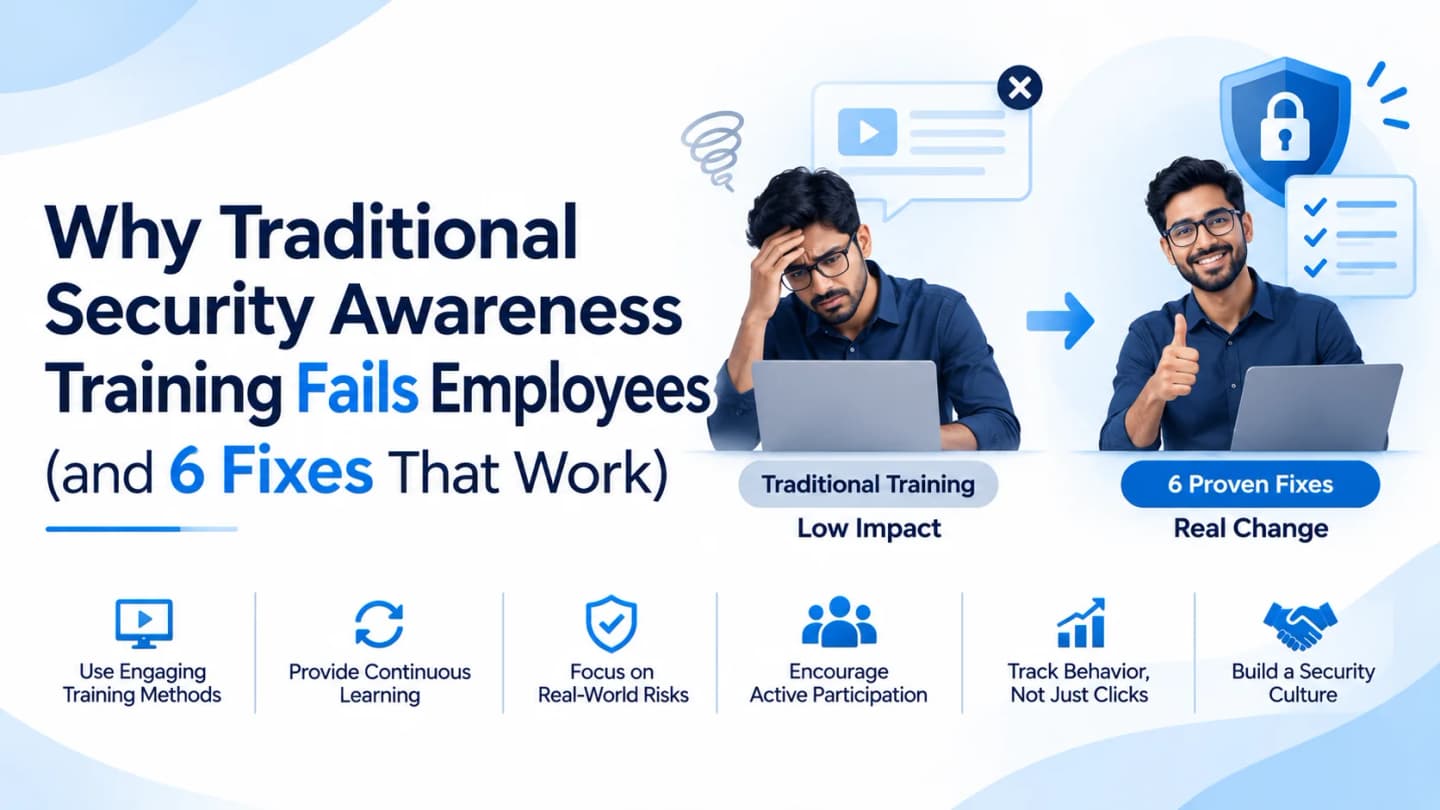
Quick answer: Knowing a rule is not the same as following it under pressure. The real measure of awareness is how well employees apply what they learn when a threat shows up.
The Annual Ritual That Does Not Work
Every year the mandatory security video arrives. Employees click through a slideshow about spotting bad grammar, pass a five-question quiz and go back to work. Weeks later, a polished AI-generated spear-phishing email slips past the same employee and an account is compromised.
The problem: many programs measure whether people completed training, not whether they can apply it. Threats evolve, and employees face different risks by role, access and environment. One presentation cannot cover every situation.
What Is Traditional Security Awareness Training?
Structured education that teaches basic cybersecurity knowledge and safe practices.
Common forms:
Annual awareness presentations and recorded videos
Email-security and password guidelines
Online quizzes and assessments
Mandatory compliance courses
Policy documents and reminders
These are not useless. They introduce concepts, communicate policy and build a foundation. They fail when they are the whole strategy and no one checks whether employees can apply the lessons. An employee may know phishing emails contain suspicious links but still miss a message impersonating a familiar supplier.
Knowing a security rule does not mean someone will follow it under pressure.
7 Reasons Traditional Training Fails
1. One-Time Training Does Not Build Habits
An annual session is forgotten, and new attack techniques appear in between. Someone who learned about suspicious attachments in January may miss a convincing QR-code phish in July. Knowledge needs reinforcement through relevant activities and practice.
2. The Content Is Too Generic
Finance sees fraudulent payments, HR sees recruitment-themed phishing, IT admins face targeted credential theft, general staff meet malicious links and impersonation.
One deck for everyone ignores job responsibilities, access, communication channels, department-specific threats and the procedures people actually follow.
3. Passive Learning Does Not Test Real Behavior
Watching a video is not the same as making a security decision.
Employee A watches a phishing presentation. Employee B watches it and then takes part in a controlled simulation. Only B has applied the knowledge.
4. It Optimizes for Compliance, Not Behavior
A 98% completion rate confirms people finished an activity. It says nothing about spotting suspicious messages, reporting incidents or following verification steps.
Separate four questions:
Question | Level |
|---|---|
Did they finish it? | Completion |
Did they understand it? | Knowledge |
Can they apply it? | Behavior |
Is it improving security? | Outcomes |
NIST SP 800-50 Rev. 1 stresses behavior change, program evaluation and continuous improvement over one-time training (source).
5. Content Lags Behind Threats
Materials stuck on conventional phishing miss spear phishing, business email compromise, QR code phishing, voice phishing, AI-assisted impersonation and malicious file-sharing notices.
Review content against current threats and incidents.
See Spear Phishing vs. Phishing and QR Code Phishing.
6. Employees Fear Making Mistakes
Naming and shaming people who click simulated links breeds embarrassment and silence. Employees who fear punishment hesitate to report, and early reports are what let a SOC contain real threats.
Encourage reporting, questions and learning.
7. Training Is Disconnected From Work
Security treated as a separate admin chore does not help when someone gets an unexpected approval prompt on a busy day, or a supplier email asking to change bank details.
Tie guidance to real decisions, such as verifying payment-detail changes through an independent channel.
7 Signs Your Awareness Program Is Not Working
Warning Sign | What It May Mean |
|---|---|
High completion, repeated phishing failures | Training is not translating into behavior |
Low suspicious-email reporting | Reporting process may be unclear or hard to find |
Identical training for every department | Role-specific risks overlooked |
Outdated learning materials | Employees may not know current threats |
Repeated mistakes across campaigns | Current interventions are not working |
Employees fear reporting mistakes | The culture discourages transparency |
No meaningful performance evaluation | You cannot tell if it works |
Investigate before concluding failure. Low reporting, for example, may mean an inaccessible reporting button rather than low awareness.
6 Fixes That Work
1. Make Training Continuous
Replace the single annual session with short monthly sessions, regular reminders, scenario-based activities, periodic phishing simulations, follow-up after incidents and updates when threats emerge.
Short, focused activities reinforce concepts without pulling people away from work.
2. Introduce Role-Based Learning
Department | Topics |
|---|---|
Finance | Payment fraud, invoice phishing, BEC |
HR | Recruitment scams, employee data protection |
IT | Credential theft, privileged access security |
Management | Executive impersonation, targeted phishing |
General employees | Email security, malicious links, reporting |
3. Use Phishing Simulations
Instead of explaining phishing, observe whether employees recognize suspicious messages, avoid unsafe interactions and report threats.
Results reveal common mistakes, department gaps, reporting weaknesses, training needs and behavior changes between campaigns.
The aim is to learn, not to catch people out.
Start with What Is Phishing Simulation?.
4. Give Immediate, Relevant Feedback
If someone clicks a simulated document-sharing link, explain how attackers imitate file-sharing notices rather than serving a long generic lesson.
Feedback tied to the actual decision sticks.
5. Measure More Than Completion
Track training completion, assessment results, click rate, reporting rate, submission attempts, behavior changes and incident-reporting trends.
Falling interactions plus rising reporting suggests improvement, but no single metric proves you are secure; read results alongside scenario difficulty, technical controls and actual outcomes.
See Phish-Prone Percentage Explained.
6. Build a Positive Security Culture
Recognize people who report suspicious messages, offer clear reporting procedures, communicate security updates regularly, give constructive feedback, welcome questions and avoid unnecessary blame.
Traditional vs. Modern Awareness Training
Area | Traditional | Modern |
|---|---|---|
Frequency | Often annual | Continuous reinforcement |
Learning style | Mostly passive | Interactive and practical |
Content | Generic | Role-based and relevant |
Evaluation | Completion and quizzes | Knowledge and behavior |
Phishing awareness | Theory | Controlled simulations |
Feedback | Limited or delayed | Scenario-specific |
Measurement | Course completion | Multiple indicators |
Culture | Compliance-focused | Learning and improvement |
A modern program can still include slideshows and compliance courses. The difference is that education becomes part of an ongoing process.
Compare approaches in depth: Phishing Simulation vs. Traditional Security Training.
Build the replacement with How to Build an Effective Security Awareness Training Program.
How Technology Helps (and Its Limits)
Running an ongoing program through disconnected tools gets heavy: preparing materials, sending simulations, tracking interactions, organizing reports and measuring campaigns.
Dedicated platforms can centralize campaign management, templates, employee targeting, scheduling, training content, interaction tracking, reporting and campaign comparison.
Microsoft's Attack Simulation Training serves eligible Microsoft 365 organizations, and PhishTop by Penough supports phishing simulation and awareness activities, including localized Bangla and English scenarios.
Choose by security requirements, integrations, reporting, employee experience and budget. Technology should support your learning strategy, not replace it.
Turn awareness into measurable behavior: Explore PhishTop.
Frequently Asked Questions
Why does cybersecurity awareness training fail?
Usually because programs rely on one-time sessions, generic content, passive learning and completion metrics without checking real behavior.
How often should employees be trained?
Ongoing: onboarding, periodic refreshers and regular practice, matched to risk and role, not just once a year.
Is phishing simulation better than traditional training?
They do different jobs. Training builds knowledge; simulation shows how people respond. Use both.
How do you measure effectiveness?
Knowledge assessments, simulation results, reporting behavior, completion and relevant security outcomes, together and over time.
Should training differ by department?
Yes. Role-based training maps to responsibilities, access and the threats each group meets.
Awareness vs. training?
Awareness helps people recognize risks and responsibilities; training builds the skills to perform specific security tasks.
Bottom Line
Traditional training is not worthless. Presentations, videos, policies and compliance courses build a foundation. The mistake is assuming completion equals capability.
Build a continuous, role-based, practical program with a supportive culture, and judge it by what employees do when a threat appears.
The real measure of security awareness is not how many employees complete a course. It is how effectively they apply what they learn when a security threat appears.
Keep Reading
Guide | Why |
|---|---|
The pillar overview | |
The wider risk picture | |
How to Build an Effective Security Awareness Training Program | The fix, step by step |
References: NIST SP 800-50 Rev. 1 · NIST: From Compliance to Impact · NIST: Phishing With a Net · CISA: Secure Your Business