


Human risk refers to the possibility that people's actions, decisions, or access privileges could expose an organization to security threats. Reducing it requires more than blaming employees. It involves combining role-based awareness, phishing simulations, strong identity controls, simpler secure workflows, and a workplace culture where people feel safe reporting security concerns.
In This Guide
Firewalls Don't Fix Everyday Decisions
What Is Human Risk in Cybersecurity?
Why Human Risk Is Hard to Manage
How to Identify and Assess Human Risk
10 Practical Strategies
How to Measure Reduction
A 90-Day Plan
How Security Platforms Help
FAQ, Bottom Line and Keep Reading
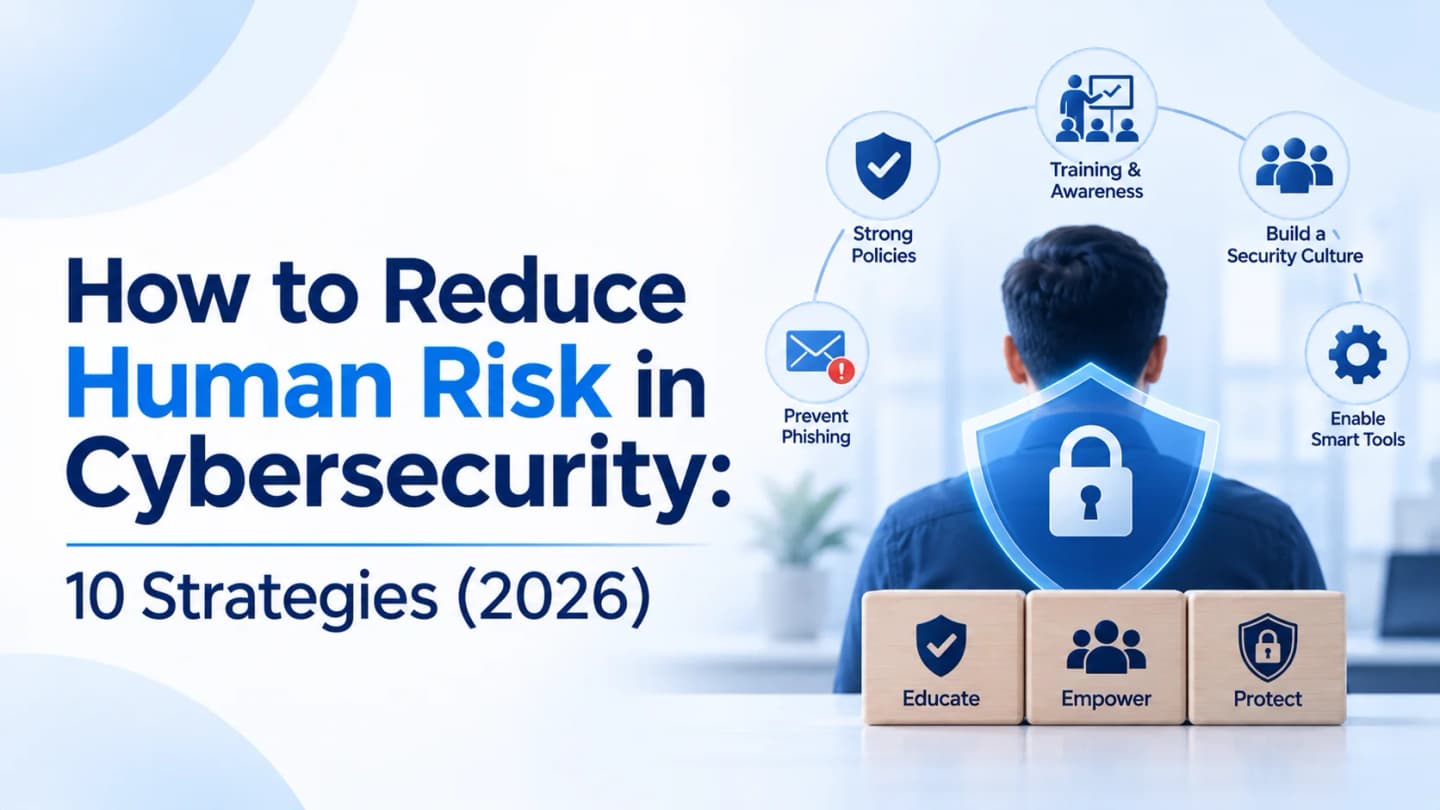
Quick answer: Identify who has access to critical systems and information, provide role-specific training, conduct authorized simulations, strengthen access controls, simplify secure workflows, verify sensitive requests, and measure employee behavior rather than training completion alone.
Firewalls Don't Fix Everyday Decisions
Organizations can invest heavily in firewalls, endpoint protection, MFA, and security monitoring while remaining vulnerable to everyday decisions. An employee might accidentally share a file with the wrong person, approve an unexpected login request, reuse a password, or grant excessive permissions to a third-party application. These situations create human risk.
Reducing this risk does not mean blaming employees for mistakes. It means understanding how people interact with technology and improving processes so that choosing the secure option becomes easier.
What Is Human Risk in Cybersecurity?
Human risk in cybersecurity is the possibility that people's actions, decisions, access privileges, or workplace interactions could expose an organization to security threats. It can result from accidental mistakes, unsafe practices, malicious behavior, or attackers manipulating legitimate users.
This risk extends beyond employees. Contractors, administrators, vendors, and business partners can also introduce exposure.
Risk area | Example |
|---|---|
Phishing and social engineering | An employee submits credentials through a fraudulent login page |
Weak authentication habits | Reusing the same password across multiple services |
Accidental data exposure | Sharing a confidential file with the wrong recipient |
Excessive access | An employee retains permissions after changing roles |
Unsafe software use | Storing business information in unapproved applications |
Insider risk | Authorized access being misused, intentionally or unintentionally |
Process weaknesses | Approving a sensitive payment without independent verification |
These risks involve technology, access, policies, and workplace culture. Consequently, security awareness training alone cannot address the entire problem.
Why Human Risk Is Hard to Manage
Challenge | What is going on |
|---|---|
Attackers exploit trust | Attackers use familiar names, ongoing projects, and urgency to make fraudulent requests appear legitimate. The challenge is verifying believable requests, not simply spotting spelling mistakes. |
Access differs by role | Finance teams handle payments, HR manages employee records, and IT administrators maintain infrastructure. A compromised account can therefore have very different consequences depending on its role. |
Processes encourage shortcuts | When secure file sharing becomes difficult, employees may turn to personal cloud storage. This indicates a workflow problem, not just a lack of awareness. |
Insider risk is not always intentional | Accidents, compromised accounts, negligence, and deliberate misuse are all possible. Investigations should consider context and evidence while respecting privacy. |
How to Identify and Assess Human Risk
Begin by asking three important questions: Who has access to critical systems and information? What actions could expose those assets? Which weaknesses could cause the greatest damage?
Identify critical roles and access. Identify administrators and privileged users, finance and payment teams, HR and customer support staff, employees handling confidential information, and vendors with system access. Evaluate whether each person's permissions are necessary.
Review behaviors and processes. Look for recurring data-handling mistakes, unreported suspicious emails or login attempts, unauthorized application usage, password or authentication policy violations, and inconsistent verification of sensitive requests. A single mistake does not automatically make an employee "high risk".
Use simulations and exercises. Authorized phishing simulations and practical exercises involving incident reporting, payment-change verification, and sensitive-data handling can reveal weaknesses. Use the results to strengthen defenses rather than embarrass or punish employees.
Assess by business impact. Consider the sensitivity of accessible information, privilege levels, external communication exposure, existing security controls, and the potential financial, operational, and reputational consequences of an incident. Use these findings to establish priorities rather than rank individual employees.
10 Practical Strategies to Reduce Human Risk
Human risk management is most effective when security awareness, technology, and business processes work together.
# | Strategy | What to do |
|---|---|---|
1 | Role-based awareness | Train finance teams on payment fraud, supplier impersonation, and verification. Educate IT administrators about privileged access, account security, and suspicious system activity. Avoid delivering identical content to every employee. |
2 | Regular phishing simulations | Conduct realistic, authorized simulations without collecting actual passwords. Monitor changes across campaigns and reinforce suspicious-email reporting. See How to Run a Phishing Test on Employees. |
3 | Strengthen identity and access | Enforce MFA, introduce passkeys where supported, apply least-privilege access, review privileged accounts, remove permissions when employees change roles or leave, and monitor suspicious sign-ins. |
4 | Make secure behavior easier | If employees repeatedly bypass a procedure, improve the process. Provide approved file-sharing options, one-click reporting, secure defaults, automated access requests, and straightforward verification steps. |
5 | Clear data-handling rules | Establish clear guidelines for storing confidential documents, sharing files, handling customer and employee information, using removable media, disposing of records, and working with personal devices and cloud services. |
6 | Supportive security culture | Blaming employees discourages reporting. Establish clear reporting channels, involve leadership, provide constructive feedback, recognize positive behavior, and handle incidents consistently. |
7 | Verification for sensitive requests | Independently verify supplier bank-detail changes, urgent payments, requests involving sensitive employee information, password resets, and privileged-access requests through previously established contact channels. |
8 | Manage insider and third-party risk | Define access requirements before granting permissions, include security responsibilities in agreements, review third-party access, revoke it when contracts end, manage employee transfers and departures, and investigate incidents fairly and proportionately. |
9 | Prepare people to report and respond | Explain where employees should report incidents, what information to include, whom to contact if data may be exposed, what actions to avoid (such as deleting evidence), and how to escalate concerns. The security team should respond promptly. |
10 | Review continuously | Use incident findings, access reviews, employee feedback, simulation results, and business changes to update the program. NIST's guidance on learning programs recommends a lifecycle that includes evaluation and continuous improvement. |
How to Measure Human Risk Reduction
Training completion percentages alone cannot demonstrate that human risk has decreased. Combine behavioral, technical, and operational indicators to evaluate progress.
Metric | What it tells you |
|---|---|
Phishing reporting rate | Whether employees report simulated or suspicious messages |
Time to report | How quickly suspicious activity reaches the security team |
Repeat simulation failure | Whether risky behavior continues across campaigns |
MFA adoption | How widely stronger authentication is implemented |
Access review completion | Whether unnecessary permissions are being removed |
Policy violation trends | Whether recurring behavioral or process-related weaknesses are decreasing |
Incident reporting trends | Whether employees identify and escalate security concerns |
Training assessment results | Whether employees understand security procedures |
Interpret these metrics together. An increase in reported suspicious emails may indicate better employee awareness rather than an increase in attacks. Similarly, a low phishing click rate does not mean human risk has disappeared.
Learn more about interpreting PPP in Phish-Prone Percentage Explained.
A 90-Day Human Risk Reduction Plan
Phase | Key actions |
|---|---|
Days 1–30: Assess | Identify critical roles, review access privileges, examine recent incidents, and identify major process weaknesses. |
Days 31–60: Strengthen | Improve MFA coverage, review permissions, introduce role-based awareness, and establish clear reporting procedures. |
Days 61–90: Evaluate | Conduct controlled simulations, measure employee responses, review access changes, and update the plan. |
This is a starting framework, not a compliance requirement. Adapt it to your organization's size, risk level, and available resources, and continue reviewing it after the first 90 days.
How Security Platforms Can Help
Phishing simulation tools, identity management systems, endpoint protection, security monitoring, and incident-reporting solutions each address different aspects of human risk.
PhishTop by Penough supports controlled phishing simulations, employee-response evaluation, and campaign reporting as part of a broader security program.
However, no single platform can eliminate human risk. Effective management requires clear policies, appropriate access controls, employee education, and responsive business processes working together.
Compare available options in Best Phishing Simulation Tools for Businesses in 2027.
Start with the human layer: Explore PhishTop.
Frequently Asked Questions
What is human risk in cybersecurity?
Human risk refers to security exposure caused by people's actions, decisions, access privileges, and interactions with systems. It includes mistakes, social engineering, compromised accounts, and insider misuse.
How can businesses reduce it?
Businesses can reduce human risk through role-based awareness, phishing simulations, MFA, least-privilege access, secure workflows, clear reporting procedures, and regular security reviews.
Is human risk the same as insider threat?
No. Human risk is a broader concept that includes accidental mistakes, external manipulation, compromised accounts, and insider misuse. Insider threats specifically involve potential harm associated with people who have authorized access.
Can phishing simulations reduce human risk?
Yes. Phishing simulations can identify risky behavior and reinforce safer practices when scenarios are realistic, feedback is constructive, and the results lead to further improvements.
How do you measure human risk?
Measure it using phishing reporting rates, repeated simulation outcomes, access review results, MFA adoption, incident-reporting trends, and employees' understanding of security procedures.
Bottom Line
Reducing human risk requires more than telling employees to avoid suspicious links. Organizations need to understand how people use their systems, identify weak processes, remove unnecessary access, and make secure behavior practical and encouraged.
Employees are not the weakest link. With appropriate controls, clear procedures, and the right support, they can become an important part of an organization's defense.
Keep Reading
Guide | Why |
|---|---|
The pillar overview | |
How to Build an Effective Security Awareness Training Program | The training component |
What to avoid |
References: NIST SP 800-50 Rev. 1 · NIST SP 1308 · NIST Cybersecurity Framework 2.0 · CISA Insider Threat Mitigation Guide · Canadian Centre for Cyber Security: insider risk resilience