


An effective security awareness program is more than an annual training video. It is an ongoing process of identifying risks, teaching role-specific skills, practicing through simulations, measuring employee behavior, and continuously improving. This guide walks you through 10 practical steps and provides a ready-to-use 90-day rollout plan.
In This Guide
What Is a Security Awareness Training Program?
Why It Matters
Awareness vs. Training
The 10 Steps
A 90-Day Starter Plan
7 Mistakes That Sink Programs
How PhishTop Supports Your Program
FAQ and Keep Reading
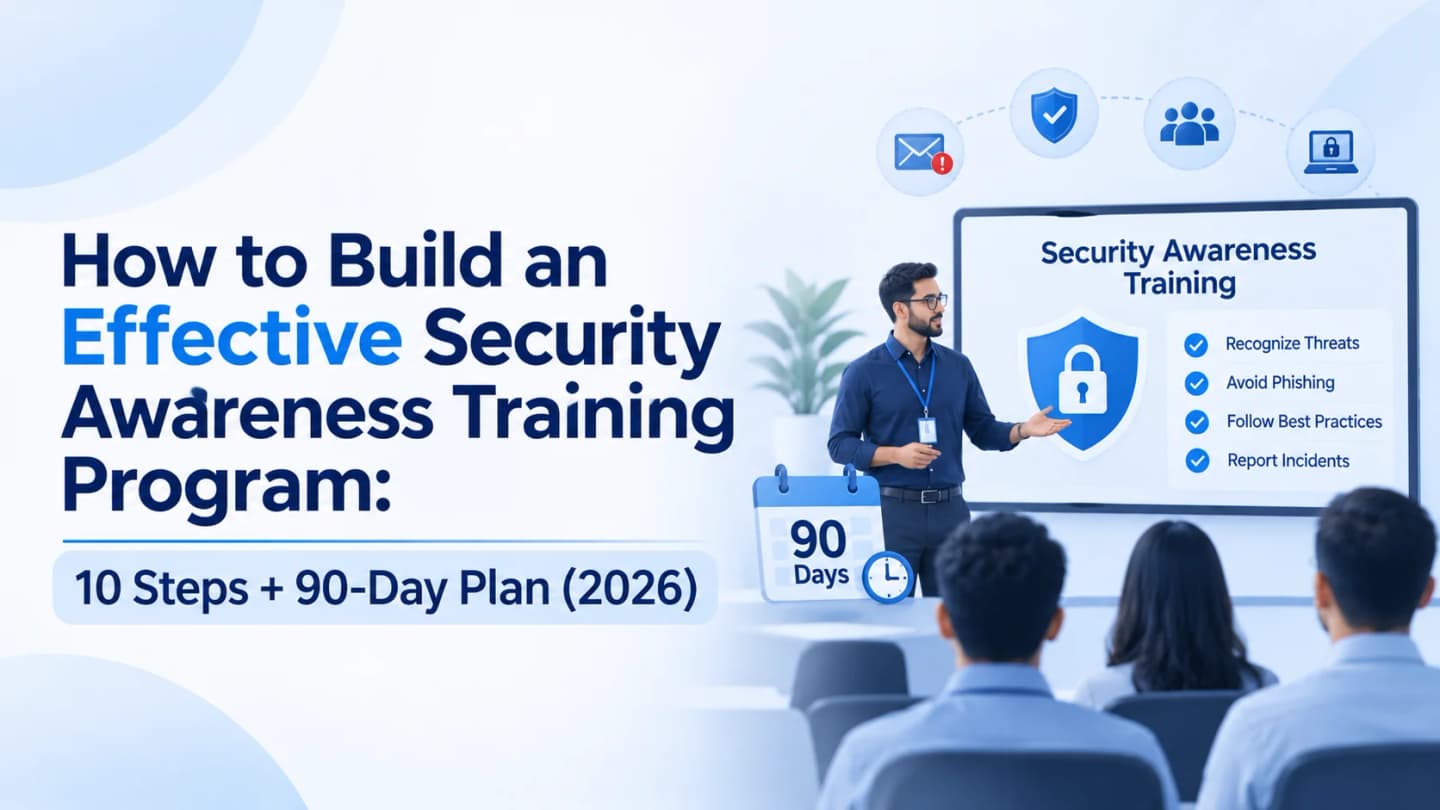
Quick answer: Assess your organization's risks, establish measurable goals, tailor training to different roles, combine learning methods, introduce authorized phishing simulations, maintain a consistent schedule, measure behavior rather than completion alone, and review the program regularly.
What Is a Security Awareness Training Program?
A security awareness training program is a structured initiative that teaches employees about cyber threats, organizational security policies, and safe digital practices. Common topics include phishing and social engineering, passwords and MFA, safe email and internet use, data protection, malware and ransomware, mobile and remote-work security, incident reporting, insider threats and access, and physical security.
The key difference between a program and a one-time presentation is practical application. Employees might first learn how to identify suspicious emails through a short training module and then participate in a controlled phishing simulation to test whether they can apply that knowledge. The objective is to make security awareness a regular part of everyday work.
Why It Matters
Benefit | How it shows up |
|---|---|
Fewer human-related incidents | Employees recognize risky links, weak passwords, and unexpected requests |
Better phishing awareness | Staff identify unusual senders, urgent requests, suspicious payment instructions, and attempts to bypass approval processes |
Stronger data protection | Employees understand data classification, secure sharing, and access rules |
Faster incident reporting | Suspicious attachments and unexpected MFA prompts are reported instead of ignored |
Shared security culture | Security becomes everyone's responsibility rather than just IT's job |
Awareness vs. Training: What's the Difference?
Security awareness | Security training |
|---|---|
Recognizing phishing emails | Practicing phishing analysis |
Understanding password risks | Using password managers and MFA |
Knowing how to report an incident | Following the incident-reporting procedure |
Understanding data protection | Applying data classification rules |
An effective program combines both. Everyone needs foundational security awareness, while employees in specific roles require deeper, job-related training.
The 10 Steps
Step 1: Assess Your Needs
Build your program around actual organizational risks rather than relying on a generic list of topics. Review previous incidents, common employee mistakes, existing policies, the data employees handle, business tools, current security controls, employee roles and access levels, and any training already in place.
Use surveys, interviews, assessments, and phishing simulation results to identify knowledge gaps. For example, if employees frequently struggle to identify fake invoices, prioritize payment verification and business email compromise (BEC) training.
Step 2: Set Measurable Goals
Replace vague objectives such as "make employees more aware" with outcomes that can be measured:
Improve phishing recognition.
Increase suspicious-email reporting.
Improve MFA adoption.
Reduce unsafe handling of sensitive data.
Increase completion of role-specific training.
Connect each objective to a relevant metric. For example, compare suspicious-email reporting rates and simulated-phishing interactions across different campaigns.
Step 3: Segment by Role
Group | Core topics |
|---|---|
All employees | Phishing, passwords, MFA, safe browsing, reporting |
Finance | Invoice fraud, payment verification, BEC |
HR | Employee data protection, recruitment scams, identity verification |
IT admins | Privileged access, secure configuration, escalation |
Developers | Secure coding, secrets management, application security |
Executives | Targeted social engineering, impersonation, handling sensitive information |
Remote staff | Secure Wi-Fi, device protection, VPN, physical security |
Step 4: Choose the Right Topics
Phishing and social engineering: Cover email phishing, spear phishing, BEC, smishing, vishing, QR code phishing, and impersonation.
Passwords and MFA: Teach employees to use unique passwords and password managers, and never approve an MFA request they did not initiate.
Data protection: Explain data classification, secure sharing, access permissions, DLP, privacy, and secure disposal.
Malware and ransomware: Cover suspicious downloads and attachments, unauthorized software, warning signs, and software update hygiene.
Safe internet and email use: Teach employees to verify websites, inspect attachments, and use approved tools.
Remote and mobile security: Cover device locking, updates, approved remote-access tools, and reporting lost devices.
Incident reporting: Explain how to stop, report through the official channel, notify the security team, preserve information when instructed, and follow response guidance.
Step 5: Pick Your Training Methods
Method | Best for |
|---|---|
Instructor-led workshops | Topics that require discussion and demonstration |
Online modules | Short lessons with knowledge checks |
Newsletters | Regular, concise security tips and recent threat examples |
Internal campaigns | Highlighting a specific topic, such as passwords or phishing |
Phishing simulations | Testing employee behavior with immediate feedback (see What Is Phishing Simulation?) |
Quizzes | Reinforcing concepts without adding pressure |
Step 6: Set a Consistent Schedule
One-time training sessions tend to lose their impact over time. Establish a consistent schedule and adapt the following illustrative cadence to your organization's size and risk level.
Frequency | Activity |
|---|---|
Onboarding | Core awareness training for every new hire |
Monthly | Short topic, newsletter, or reminder |
Quarterly | Phishing simulation or practical exercise |
Every 6 months | Knowledge assessment and program review |
Annually | Comprehensive refresher |
As needed | Targeted training following incidents, policy changes, or emerging threats |
Step 7: Make It Practical and Engaging
Use realistic examples, short interactive exercises, simple language, clear reporting procedures, and recognition for positive security behavior.
Instead of simply defining business email compromise, demonstrate how an attacker might impersonate a supplier and request a change to payment details. Then show employees how to verify the request through an independent, trusted communication channel.
Step 8: Combine Training With Phishing Simulations
Quizzes help determine whether employees understand a concept, while simulations reveal whether they can apply that knowledge in practice.
Follow a continuous cycle:
Deliver training.
Run an authorized phishing simulation.
Review the results.
Provide feedback and follow-up training.
Introduce a different simulation scenario.
Compare the results.
Phishing simulations should support learning, not punish employees. Learn more in How to Run a Phishing Test on Employees.
Step 9: Measure Effectiveness
Metric | Formula |
|---|---|
Training completion rate | Completed ÷ assigned × 100 |
Assessment score | Correct answers ÷ total questions × 100 |
Phishing reporting rate | Unique reporters ÷ delivered simulation emails × 100 |
Phishing click rate | Unique clickers ÷ delivered simulation emails × 100 |
Repeat risky interaction rate | Same employees repeating risky actions across campaigns |
Incident reporting behavior | Whether employees follow the reporting process |
Evaluate these metrics together. A high training completion rate alone does not demonstrate that employees can recognize sophisticated social engineering attacks.
Use four perspectives to assess effectiveness:
Knowledge: Assessment results.
Behavior: Phishing simulation results.
Response: Reporting activity and response speed.
Improvement over time: Changes across training cycles and campaigns.
A declining phishing click rate alongside an increasing reporting rate can indicate progress, but neither metric proves that an organization is secure. Learn more about interpreting PPP in Phish-Prone Percentage Explained.
Step 10: Review and Improve Continuously
Regularly reassess emerging phishing techniques, system and policy changes, employee feedback, assessment and simulation results, incident lessons, training completion rates, and changes in employee roles.
A program that remains unchanged for years will eventually become outdated. Treat security awareness as a continuous cycle of assessment, learning, evaluation, and improvement. This lifecycle approach is also supported by NIST SP 800-50 Rev. 1.
A 90-Day Starter Plan
Days | Activities | Outcome |
|---|---|---|
1–15 | Assess risks, review policies, identify employee groups | Priorities established |
16–30 | Develop materials, define objectives, run a baseline assessment | Initial awareness level established |
31–45 | Deliver foundational training | Core security practices understood |
46–60 | Run an authorized phishing simulation and practical exercises | Employee behavior assessed |
61–75 | Deliver targeted training on weak areas | Identified gaps addressed |
76–90 | Conduct a follow-up assessment, review metrics, and plan the next cycle | Progress evaluated |
This is an illustrative framework, not a compliance requirement. Continue improving the program beyond the first 90 days.
7 Mistakes That Sink Awareness Programs
Mistake | Fix |
|---|---|
One-time annual training | Reinforce security awareness continuously |
Same content for everyone | Introduce role-based training modules |
Too technical | Use plain language and practical examples |
Measuring only completion | Include simulation and behavioral metrics |
Ignoring feedback | Survey employees and adjust the program |
Fear-based messaging | Teach clearly and demonstrate safer actions |
No reporting process | Establish one simple reporting channel |
Why do so many security awareness programs fail to deliver lasting results? Explore Why Traditional Security Awareness Training Fails Employees. For a broader understanding of organizational exposure, see How to Reduce Human Risk in Cybersecurity.
How PhishTop Supports Your Program
PhishTop by Penough provides teams with a structured way to conduct phishing simulations, target specific departments or roles, deliver teachable-moment micro-training, track employee interactions, and review human-risk insights and reports. This helps organizations avoid relying on disconnected spreadsheets and manual follow-ups.
Want to make your awareness program measurable? Explore PhishTop.
Frequently Asked Questions
What should a security awareness program include?
It should cover phishing awareness, passwords and MFA, data protection, malware awareness, safe browsing, remote-work security, social engineering, and incident reporting.
How often should employees be trained?
Training should be continuous. Include onboarding sessions, periodic refreshers, monthly touchpoints, and regular practical exercises, adjusting the frequency to your organization's risk level.
How do you make training more effective?
Use relevant examples, role-based learning, short interactive modules, simulations, assessments, and a clear process for reporting suspicious activity.
How do you measure effectiveness?
Track training completion, assessment scores, phishing reporting and click rates, repeat risky interactions, and incident-reporting behavior together over time.
Can small businesses do this?
Yes. Small businesses can begin with phishing, passwords, MFA, data protection, and incident reporting, then expand the program as the organization grows.
What is role-based training?
Role-based training matches learning content to employees' responsibilities and access levels. For example, finance teams receive payment-fraud training, while developers receive secure-coding guidance.
Keep Reading
Guide | Why |
|---|---|
The pillar overview | |
Understand the practice component | |
Why you need both |
References: NIST SP 800-50 Rev. 1 · CISA: Secure Your Business